Embroidered vs Woven Patches: Which Is Right for Your Logo?
You've got a great logo and now you have to pick a patch. Embroidered patches give your design a raised, textured look, while woven patches hold fine lettering and small details. Choose wrong and your logo loses its punch.
This guide breaks down how each patch is made, what kinds of logos each does best, and how they compare on detail, durability, feel, and cost. By the end, you'll know which patch type fits your logo and how ordering from The Monterey Company works.
What Is The Monterey Company?
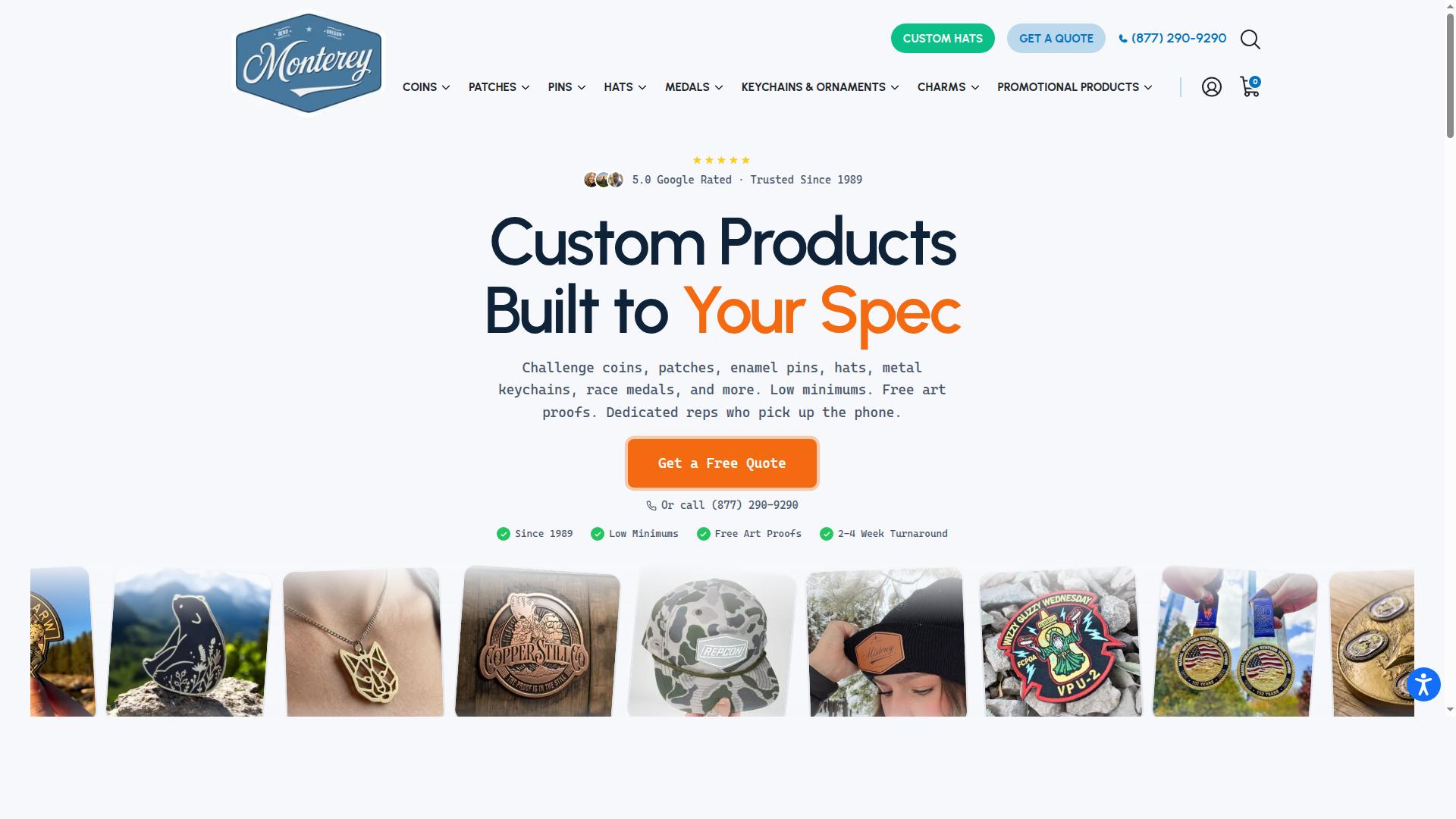
The Monterey Company is a custom product manufacturer that has been making embroidered and woven patches, along with coins, pins, and other promotional items, for more than 35 years. Founded in 1989, the company is based in Bend, Oregon and has delivered over 100,000 custom orders.
Its patch lineup covers several patch types, including embroidered, woven, PVC, and leather. That range matters when you're choosing between embroidery and weaving, since both options come from the same shop.
The company works with small businesses, major brands, military groups, schools, and event organizers. Patches start at a 50 piece minimum, and free art proofs with unlimited revisions come with every order.
Customers have rated the company 5.0 on Google across more than 550 reviews, with a 4.8 on Trustpilot. A 21 day satisfaction policy backs each order, and reorders with identical artwork skip setup charges.
Embroidered vs Woven Patches: The Short Answer
If you need a patch with bold colors, raised texture, and a classic look, choose embroidered; if your design has fine details, small text, or complex gradients, choose woven.
Here's the quick breakdown:
- Embroidered patches use thread stitched onto fabric like twill. The result is a raised, textured look that works well for simple, bold logos.
- Woven patches use threads woven together to create a flat image. This method handles intricate designs and fine lettering much better.
Think of it this way: embroidery shines with bold shapes, while weaving shines with detail. Match the method to your logo and you'll get a patch that looks right.
How Embroidered Patches Are Made - and What They Do Best
Embroidered patches are created by stitching colored threads onto a fabric backing, building up layers to form your design. Most patches use polyester, rayon, or cotton thread over a twill base, and the stitch count and thread density decide how much detail the finished patch can hold.
More stitches mean more texture and sharper edges, but they also add weight and cost. A denser stitch pattern gives a richer look, while a lighter stitch count keeps the patch softer and more flexible.
The result is a raised, dimensional patch with real texture you can feel. That raised embroidery is why this patch type holds up well on uniforms, hats, and jackets, and why it resists wear and washing better than a flat printed surface.
At The Monterey Company, custom patches are quoted around the details that matter to buyers: artwork, size, thread colors, border style, and backing options like iron-on, sew-on, adhesive, or hook-and-loop. A free proof lets you check the design before production starts.
Ideal logos and use cases for embroidery
Embroidery works best for logos with bold shapes, thick lines, and solid colors, such as team mascots, company logos with large lettering, and military insignia. If your artwork has fine text, tiny lettering, or gradients, embroidery will simplify it, and that's usually a good thing to know before you order.
Here are the logo types that tend to look sharp in thread:
- Simple geometric shapes with clean edges and open space
- Bold, thick lettering that reads well from a few feet away
- Mascots and characters with solid blocks of color
- Limited color designs (a handful of thread colors keeps it crisp)
The stitching process can't capture very fine details or tiny text well. Threads have a physical width, so thin strokes and small gaps can fill in or blur. Designers often thicken lines and drop tiny copy so the patch reads clearly.
Common uses include uniforms, caps, jackets, and event giveaways where a classic, textured look is the goal. These patches handle regular washing and daily abrasion, which makes them a practical pick for workwear and team gear.
If your logo is bold and built from a few solid colors, embroidery is a natural fit. If it's packed with fine detail, a woven patch may serve you better. Request a free quote and a proof to see how your artwork translates to thread.
How Woven Patches Are Made - and What They Do Best
Woven patches are made by weaving colored threads together on a loom, creating a flat, highly detailed image that can capture fine lines and small text. Instead of stitching thread on top of a fabric base, the design is built into the cloth itself.
Because the threads interlock tightly, the surface stays smooth and even. That structure is what lets weaving hold fine text and tight detail that embroidery often struggles with.
The result is a flat weave with a clean, printed-like look. There's no raised texture, so the patch sits low and looks sharp from a distance.
Woven patches are often the pick for complex logos. Detailed crests, small taglines, and multi-color artwork tend to translate well. The trade-off is a flatter feel, which some buyers love and others don't.
Edge finishing works the same as with other patch types. You can choose a merrowed border for a rounded, stitched rim or a laser-cut border for a cleaner outline. Backing options like sew-on, iron-on, adhesive, or hook-and-loop are also available.
Ideal logos and use cases for weaving
Woven patches are the go-to choice for logos with small lettering, fine lines, or complex gradients, such as detailed emblems, school crests, and corporate logos with taglines. The tight weave lets those small elements stay readable.
Here's where weaving tends to win:
- Text smaller than 1/8 inch, where stitched letters would blur together
- Gradient colors and blended shades that shift across the design
- Intricate patterns like fine linework, tiny icons, or dense detail
- Logos with many colors packed into a small space
Weaving reproduces these details because the threads sit closely together. There's less space between elements, so thin lines and small fonts hold their shape. That's the main reason detail resolution is the strong point of this patch type.
Common use cases include fashion brands that want a polished label look, school uniforms and crests, and promotional items where a crisp, detailed finish matters. Police, fire, and security patches with fine text also fit well here.
One practical tip: keep very fine lines at least a thread wide, and avoid tiny gaps between colors. A good proof will show whether your artwork holds up before production starts. If you're unsure, ask for a free proof so you can check the detail on screen first.
Side-by-Side Comparison: Detail, Durability, Feel, and Cost
When comparing embroidered and woven patches, consider four key factors: detail resolution, durability, feel, and cost. Each patch type handles these differently, so the right pick depends on your logo and how the patch will be used.
Here's a quick look at how they stack up.
| Factor | Embroidered Patches | Woven Patches |
|---|---|---|
| Detail | Great for bold shapes and simple text | Great for fine text, small lettering, and gradients |
| Durability | Durable, but raised thread can snag | Durable and flatter, resists abrasion well |
| Feel | Raised, textured, dimensional | Smooth, flat weave |
| Cost | Often less expensive for simple designs | May cost more for complex artwork, but prices vary |
Detail resolution is where the two types really split. Embroidery builds your logo from stitches, so thin lines, tiny lettering, and color blending get tricky. Woven patches are created thread by thread on a loom, which lets them hold fine text and gradient colors much better.
If your logo has a lot of small print or soft color fades, weaving usually wins. If it's bold and simple, embroidery handles it well.
Durability is strong for both patch types. The difference comes down to surface texture. Raised embroidery can catch on zippers or rough edges, while a flat weave tends to resist abrasion more easily.
Both options offer good wash resistance and colorfastness when made with quality thread and fabric like polyester or rayon. Proper backing options, such as sew-on backing or heat seal, also help patches hold up over time.
Feel comes down to personal preference. Embroidered patches have a raised, dimensional texture that stands out on a jacket or cap. Woven patches feel smooth and flat, closer to a printed look.
Neither is better here. It's about the look you want for your custom patches.
Cost often favors embroidery for simple designs, since fewer stitches keep production straightforward. Weaving may cost more for intricate artwork, though prices vary by size, stitch count, thread density, and edge finishing like a merrowed border or laser-cut border.
The best way to compare is to get a quote on your actual logo. That way you see real pricing for both options before you decide.
Which Patch Type Fits Your Logo? A Decision Guide
To choose between embroidered and woven patches, start by looking at your logo's complexity: if it has fine details or small text, go woven; if it's bold and simple, go embroidered. The steps below walk you through the rest of the decision so you can pick with confidence.
Step 1: Check for fine text or small elements. Look at the smallest parts of your logo, especially any lettering under 1/4 inch tall. Woven patches handle this well because the design is built into the fabric weave, which holds fine lines and tiny lettering far better than thread stitching can.
Step 2: Look for gradients or many colors. If your logo blends colors or uses lots of shades, woven patches are usually the safer pick. The weaving process handles color blending and gradient colors more smoothly, while embroidery works best with distinct, solid color blocks.
Step 3: Consider a simple, bold logo. Thick lines and solid colors are a great fit for embroidered patches. Embroidery gives that classic raised, dimensional texture people expect from a traditional logo patch, and it tends to be cost-effective for simple artwork.
Step 4: Think about how the patch will be used. For uniforms that see heavy wear and frequent washing, both patch types hold up well, but they age differently. Embroidered patches may show abrasion or fraying on raised stitches over time, while woven patches present a flatter surface.
Step 5: Request samples or proofs. Before you commit to a full order, ask to see how your artwork translates. A proof shows whether small lettering stays legible, how colors read in thread or fabric, and whether the detail resolution meets your expectations.
A quick rule of thumb: fine and intricate points to woven, bold and simple points to embroidered. When your logo falls somewhere in between, a proof is the fastest way to settle it. Request a free quote or a free proof to see both options side by side.
The Monterey Company's Patch Options and Ordering Process
The Monterey Company offers both embroidered and woven patches, along with other patch types like PVC and leather, and a straightforward ordering process. The full lineup also includes chenille, sublimated, iron-on, and hook-and-loop patches, so you can match the material to your logo and how the patch will be used.
Every order starts with a free art proof, so you can see your design before anything goes into production. A dedicated account manager walks you through material choices, sizing, and backing options along the way. The company has been in business since 1989 and has delivered over 100,000 custom orders.
Once you pick a patch type, the next step is nailing down quantities, timing, and proof approval. Those details are covered below.
Minimums, proofs, turnaround, and guarantees
The Monterey Company requires a minimum of 50 patches for pins and patches, offers free art proofs with unlimited revisions, and standard turnaround is 2-4 weeks. Metal emblems start at 25 pieces, and hats start at 24.
Here's what to expect when you order:
- Minimums: 50 pieces for pins and patches, 25 for metal emblems, 24 for hats
- Proofs: free art proofs with unlimited revisions before production
- Turnaround: 2-4 weeks standard, with rush options depending on product type and order size
- Pricing: custom quotes only, with volume discounts available
- Reorders: no setup charges when the artwork stays the same
Pricing isn't listed publicly because every job differs by size, stitch count, thread colors, and backing. A quick quote request gets you real numbers. Samples are available upon request if you want to feel the material first.
Each order comes with a 1:1 dedicated account manager, plus design help if your artwork needs cleanup. The company backs orders with a 100% quality guarantee and a 21 day satisfaction policy. Multiple location shipments are available for teams spread across offices. Since 1989, the shop has built a 5.0 Google rating with over 550 reviews, which says a lot about how the process treats buyers.
For embroidered versus woven, the practical takeaway is simple. Woven handles fine lettering and tight detail, while embroidered gives you that raised thread texture. Either way, request a free proof and compare the two side by side before you commit.
Trust Signals: 35+ Years and Thousands of Satisfied Customers
With over 35 years in business and more than 100,000 custom orders delivered, The Monterey Company has built a track record that speaks for itself. That history matters when you're choosing between embroidered patches and woven patches for your logo.
The company has been operating since 1989. In that time it has produced custom patches, pins, coins, hats, and other items for a wide range of buyers.
Customers include small businesses, major brands, military groups, and schools. That mix says something useful. A supplier trusted by a military unit and a local shop alike has likely handled logos of every size and detail level.
Reviews back up the longevity. The company holds a 5.0 Google rating with over 550 reviews and 750+ 5-star Google reviews. It also carries a 4.8 Trustpilot rating and is 97% recommended on Facebook.
Independent coverage adds another layer. The business has been featured in the U.S. Chamber of Commerce and KTVZ News. It has also planted more than 100,000 trees.
For patch buyers, these signals reduce risk. Whether you order 50 woven patches with fine lettering or embroidered logo patches with raised texture, you can request a free art proof before production and review the details first.
Final Verdict
Both embroidered and woven patches have their strengths, and the right choice depends on your logo's complexity and your intended use. There's no single winner. There's only the patch that fits your design and where it's headed.
Here's the short version to help you decide:
- Choose embroidery for bold, simple logos with clean shapes and a classic textured look. The raised thread adds depth that stands out on hats, jackets, and bags.
- Choose weaving for fine details, small lettering, and complex designs. A flat weave holds tight lines and gradient colors that thread stitching can't always match.
Think about where the patch will live. A patch that gets heavy wear, like one on a work jacket or a backpack, often does well with the durability of embroidery. A patch that needs to show small text, like a name tag or a detailed crest, usually reads more clearly when woven.
If you're still on the fence, order a sample of each. Seeing your logo in both styles side by side settles the question fast, and most buyers know the answer the moment they hold them.
For custom patches, The Monterey Company is a solid place to start. They've been in business for 35+ years since 1989 and have delivered over 100,000 custom orders. Free art proofs with unlimited revisions come standard, so you can see your design before you commit. Patches start at a 50 piece minimum, with volume discounts and rush options available depending on your order. A 21 day satisfaction policy backs every order.
Ready to move forward? Contact The Monterey Company at (877) 290-9290 or email orders@montereyco.com. You can also visit the office at 35 SW Century Dr #110, Bend, OR 97702. Hours are 8:30 to 5:00, Monday through Friday. Request a free quote or get a free proof and see which patch type fits your logo best.
Frequently Asked Questions
What's the main difference between embroidered and woven patches?
Embroidered patches are stitched with thread directly onto a fabric backing, giving them a raised, textured look that works well for bold, simple logos. Woven patches are created by weaving fine threads together to form the design itself, which allows for much finer detail, smaller text, and smoother gradients. In short: embroidery offers texture and durability, while weaving offers precision and detail.
Which patch type is better for logos with small text or fine details?
Woven patches are generally the better choice when your logo includes small lettering, thin lines, or intricate details, since the weaving process can reproduce fine elements more faithfully than stitching. Embroidered patches tend to work best with larger, simpler designs where texture and a classic stitched look are the priority. If you're unsure, The Monterey Company includes free art proofs with unlimited revisions so you can see how your design translates before ordering.
How many patches do I need to order, and how long does it take?
The Monterey Company's minimum order quantity for patches is 50 pieces, and volume discounts are available on larger orders. Standard turnaround is 2-4 weeks, with rush options available depending on product type and order size. Custom quotes are provided for every order, so you'll know your exact cost before committing.
Can I get a sample or proof before placing a full order?
Yes. The Monterey Company offers free art proofs with unlimited revisions, and samples are available upon request. This lets you confirm the design, colors, and patch style before production. Reorders with identical artwork carry no setup charges.
Do you offer other patch styles besides embroidered and woven?
Yes. Plus embroidered and woven patches, The Monterey Company produces PVC, chenille, leather, sublimated, iron-on, and hook-and-loop patches. That range means you can match the patch style to your logo, budget, and how the patch will be used-whether it's sewn onto a uniform, attached to a hat, or handed out at an event.
Why choose The Monterey Company for custom patches?
The Monterey Company has been making custom products since 1989-over 35 years-and has delivered more than 100,000 custom orders, backed by a 100% quality guarantee and a 21-day satisfaction policy. Every order includes a dedicated 1:1 account manager and free art proofs, and the company ships internationally. With a 5.0 Google rating and 750+ five-star reviews, it's a proven option for businesses, military groups, schools, and organizations of all sizes.