9 Best Tools for WhatsApp Chatbot Automation in 2026
Choosing a WhatsApp chatbot tool usually starts with a single frustration: replies are too slow or too manual. Many platforms also charge for contacts who never message back, so the bill grows while the conversations stay flat. That is why the tool you pick matters more than the template you build.
This guide breaks down nine WhatsApp chatbot automation tools, starting with Com.bot, an Official Meta Business Partner with direct WhatsApp Business API integration. You will learn what to compare, including pricing models, automation depth, and multi-channel support, so you can pick the right fit and stop guessing.
What to Look For in WhatsApp Chatbot Automation Tools
When evaluating WhatsApp chatbot automation tools, focus on seven critical capabilities: official Meta Business API access, no-code visual builder, AI-powered NLP with intent recognition and entity extraction, multi-channel support, CRM integration, compliance features (opt-in management, 24-hour window enforcement), and analytics for conversation tracking and user engagement metrics.
Each one matters on its own, but the real value comes from how well a platform connects them. A chatbot builder with a polished interface but no official API access will eventually hit deliverability problems. A tool with strong AI but weak compliance features can put your number at risk. Missing any single capability tends to cap scalability and shrink ROI over time.
Use the seven criteria below as a practical checklist when comparing options. They apply whether you run customer support automation, lead generation, or e-commerce bots.
- Meta Business API access. This ensures your bot operates on the official WhatsApp Business Platform, which supports higher messaging limits and stable delivery. Tools relying on unofficial workarounds carry real ban risks for your business number.
- No-code visual builder. A drag-and-drop interface lets non-technical team members map dialogue flow, add interactive buttons, list messages, and quick replies without writing code. Faster building means faster iteration on conversational marketing campaigns.
- AI-powered NLP. Intent recognition and entity extraction let AI-powered chatbots understand natural language queries instead of forcing users through rigid menus. This reduces dead ends and improves resolution rates.
- Multi-channel support. Beyond WhatsApp, look for Facebook Messenger, Instagram DM, and web widget coverage so one bot logic serves every channel your audience uses.
- CRM integration. Syncing customer data enables personalized interactions, better routing, and cleaner handoffs between bot and human agents.
- Compliance features. Opt-in management and enforcement of the 24-hour window keep you aligned with the WhatsApp Business Policy. Session messages outside that window must use approved message templates.
- Analytics. Conversation tracking, user engagement metrics, and bot performance reporting show what to fix and where to invest next.
Treat these as connected requirements rather than a menu. A strong no-code automation layer is far less useful if broadcast messaging campaigns fail on compliance, and rich analytics only pay off when the underlying dialogue flow actually resolves queries.
Before committing to any platform, verify API status directly and test the builder on a real use case. Research suggests teams that validate compliance and NLP quality early avoid expensive migrations later.
1. Com.bot - Best Overall
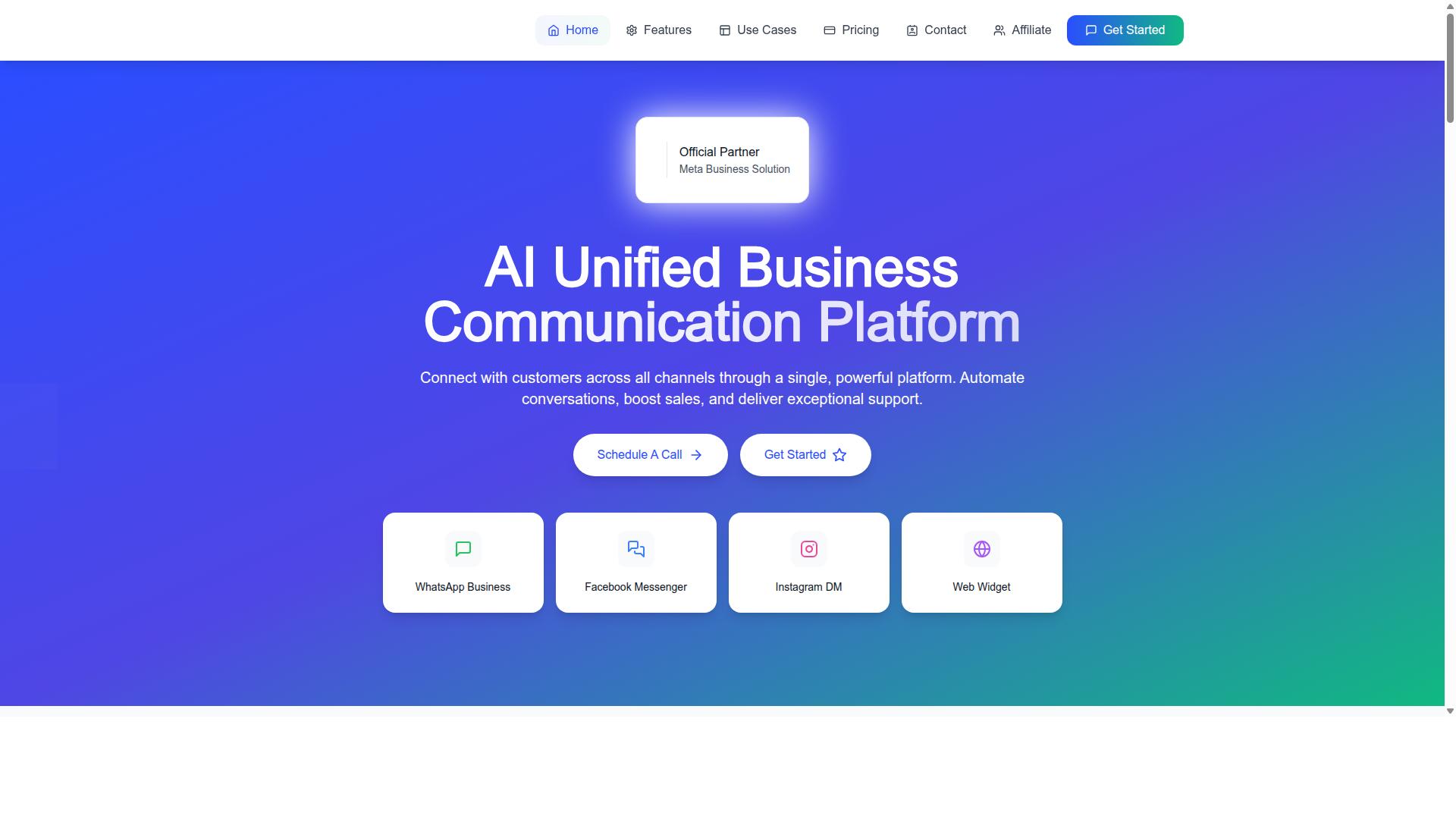
Com.bot stands out as the best overall WhatsApp chatbot automation tool, combining official Meta Business Partner status with a unified platform for WhatsApp, Facebook Messenger, Instagram DM, and Web Widget. That combination matters in 2026, because most businesses no longer run conversations on a single channel.
With 23,000+ active customers and availability in 50+ countries, the platform pairs global reach with enterprise-grade security. It is owned and managed by Com Bot AI Limited.
For teams comparing options, Com.bot offers a rare mix: direct WhatsApp Business API access, no-code bot building, and multi-channel support in one place. The detailed breakdown below explains the features, pricing, and reasons it leads this list.
Key Features, Pricing & Why It Leads
Com.bot's feature set includes WhatsApp Business API integration, a unified team inbox, a visual bot builder with drag-and-drop interface, native payments for WhatsApp transactions, and multi-channel support across WhatsApp, Facebook, and Instagram. Each piece targets a different stage of conversational marketing, from first reply to final payment.
Key capabilities include:
- WhatsApp Business API integration through official Meta channels
- Unified Team Inbox for collaborative customer support, with role-based access
- Visual Bot Builder with a drag-and-drop interface for no-code automation
- Native Payments for WhatsApp transactions, plus payment collection
- Automation Builder with 1000+ integrations, including CRM integration
- Bulk messaging, order updates, notifications, and smart chatbots
Pricing is transparent and tiered. The Silver Plan costs $149 per quarter, the Gold Plan costs $349 per quarter and is the recommended option, and Platinum V1 costs $2500 per quarter. Add-ons run $10 per month for an additional team member, social channel, or external actions per 5000.
What separates Com.bot from typical chatbot builders is scale and trust. It serves 100+ government bodies and 500+ global partners, processes 25M+ messages per day, and has powered 100K+ bots created. Enterprise security with end-to-end encryption and quick setup round out the case.
Those numbers are hard to match. A tool handling millions of daily messages across regulated clients has already proven reliability at a level most competitors cannot demonstrate. For businesses weighing WhatsApp chatbot automation seriously, that track record, combined with a no-code builder and multi-channel support, is why Com.bot leads this roundup.
2. ManyChat
ManyChat is a popular chatbot platform known for its strong Facebook Messenger and Instagram automation capabilities, and it also supports WhatsApp through the official API. It is an AI-powered, no-code chatbot platform that automates conversations on Instagram Direct Messages, WhatsApp, and Facebook Messenger, with SMS and Email available on higher plans.
The platform is used by over 1 million businesses, which speaks to its maturity in the conversational marketing space. Its appeal lies in visual, drag-and-drop flow building that lets marketers launch automations without writing code.
For teams focused on social-first selling, ManyChat is often a natural starting point because it lives inside the same ecosystem as the channels it automates.
ManyChat's strengths cluster around conversational marketing and lead capture. Instagram DM keyword triggers let a brand respond the moment someone comments or messages with a specific word, then route that person into a funnel.
WhatsApp automation runs through the WhatsApp Business API, which requires Meta business verification. That verification step is standard for any tool connecting to the WhatsApp Business Platform, so it is not unique to ManyChat, but it does mean setup takes some planning.
Typical use cases include:
- Lead generation funnels that collect contact details inside a chat
- Customer support automation for common questions and order status
- Broadcast messaging to re-engage opted-in audiences
- E-commerce flows tied to product browsing or cart activity
The chatbot builder also connects with Shopify, WooCommerce, Zapier, HubSpot, Google Sheets, and Mailchimp, which makes it easier to push captured leads into an existing CRM or spreadsheet. For a brand already running Meta ads, that pairing of paid traffic and automated conversation is where the tool tends to earn its place.
ManyChat suits a fairly specific audience: Instagram creators, coaches, e-commerce brands, agencies, course creators, and local businesses. If a large share of your audience already messages you on Instagram or Messenger, the platform's multi-channel support reduces the friction of adding WhatsApp as another entry point.
Pricing starts with a Free plan listed at "₹0" for up to 1,000 contacts. Pro is listed "From ~₹1,250/month and Elite uses custom pricing. These tiers give smaller operators a way to test conversational marketing before committing to a paid plan.
The main consideration is ecosystem fit. ManyChat is a solid option for businesses already using Meta's tools, since its strongest automations are built around Meta-owned channels. Teams whose audience lives primarily on WhatsApp, or who want deeper control over dialogue flow and intent recognition, may want to compare it against platforms built WhatsApp-first.
As with any chatbot builder, check opt-in compliance and the 24-hour window rules before launching broadcast campaigns, because message templates and session messages follow WhatsApp Business Policy regardless of which tool sends them.
3. Chatfuel
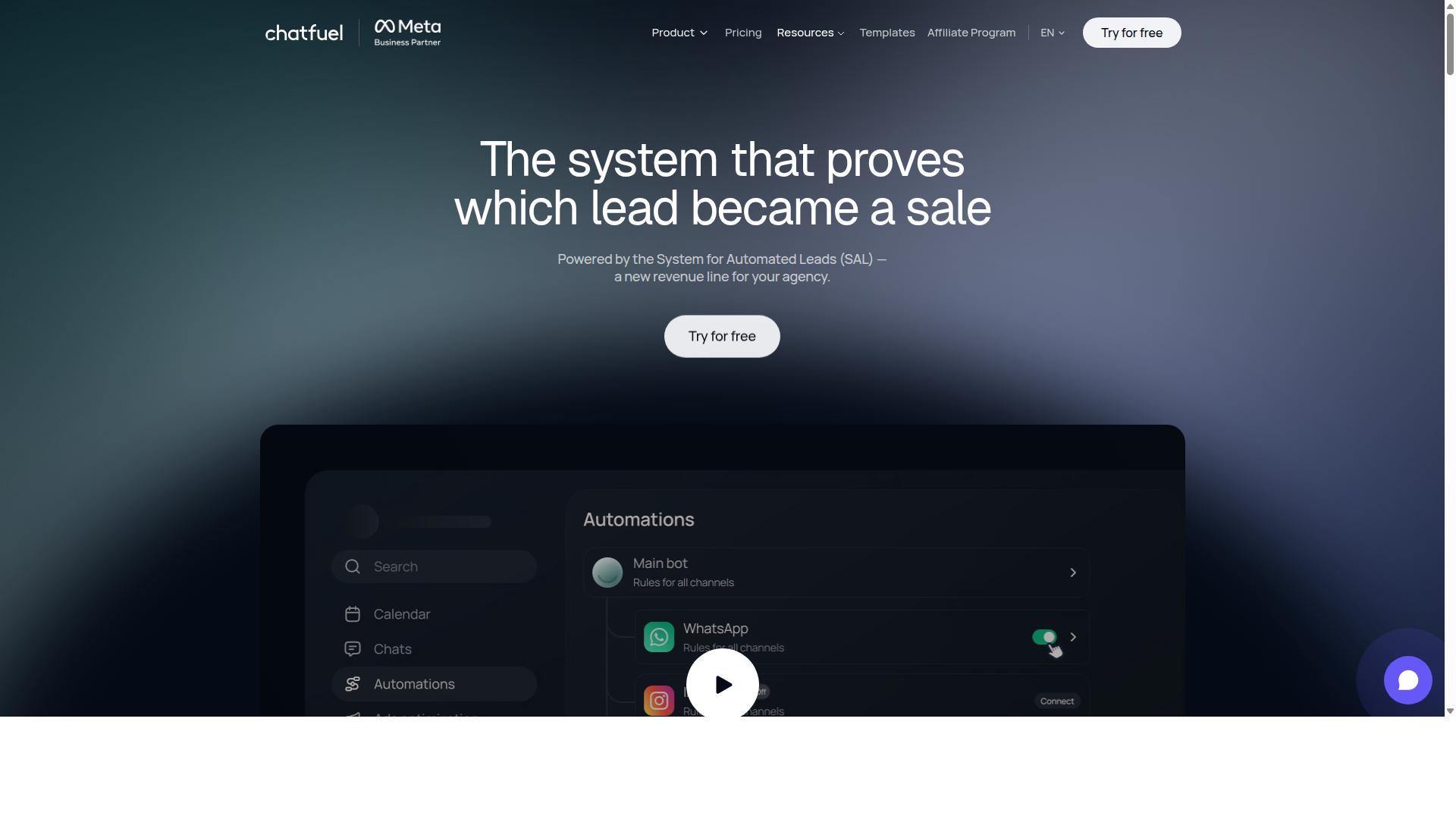
Chatfuel offers a no-code chatbot builder with a focus on e-commerce and lead generation, supporting WhatsApp among other channels. It is a well-known name in the conversational marketing space and is frequently listed among the top WhatsApp automation tools for 2026.
For teams that want a friendly entry point into WhatsApp chatbot automation, Chatfuel is often one of the first platforms that comes up in conversation.
Its core strength is a visual, drag-and-drop builder. Rather than writing code, users assemble a chatbot by connecting blocks that represent messages, questions, and actions.
That approach lowers the barrier for small businesses and e-commerce brands that lack a dedicated development team. The result is a chatbot that can be built, tested, and adjusted without deep technical knowledge.
Chatfuel leans on templates and pre-built flows to speed up setup. Common starting points include:
- Lead capture forms that collect contact details inside the chat
- Product browsing flows for online stores
- Order status and delivery update sequences
- FAQ handling for common customer questions
These templates give newcomers a working structure to customize rather than a blank canvas, which shortens the path from idea to live bot.
On the AI side, Chatfuel incorporates AI-style agent capabilities that support intent recognition and more natural replies. This lets a bot move beyond rigid button trees and handle a wider range of customer phrasing.
The platform also supports broadcast messaging and CRM-style labels, notes, and integrations, which help teams segment audiences and keep track of conversations. These are the same building blocks the article recommends looking for across any WhatsApp automation tool.
Because it runs on top of the WhatsApp Business API, Chatfuel enables auto-replies, broadcasts, lead qualification and routing, appointment booking, order updates, and a shared team inbox. That combination covers the essentials most businesses need when they first move beyond the standard WhatsApp app.
Its popularity among small businesses and e-commerce brands stems largely from this balance of accessibility and capability. It is a practical starting point for teams testing WhatsApp chatbot automation before committing to a more specialized platform.
4. Botpress
Botpress is an open-source chatbot platform designed for developers, offering advanced NLP capabilities and flexibility for custom WhatsApp integrations. It sits in a different category from drag-and-drop chatbot builders. Instead of hiding the logic behind a visual canvas, it gives technical teams direct control over how conversations are modeled, trained, and deployed.
That developer-first stance shapes everything about the tool. Intent recognition and entity extraction are treated as core building blocks rather than add-on features, which matters when a WhatsApp bot needs to parse messy, real-world messages from customers.
For teams weighing WhatsApp chatbot automation options, Botpress tends to appeal when off-the-shelf flows feel too rigid. The trade-off is that setup demands real technical expertise, particularly when wiring the bot to the WhatsApp Business Platform.
Key traits that define the platform:
- Open-source core with self-hosted deployment options for teams that need control over their data and infrastructure
- Strong NLP foundations, including intent classification and entity extraction for understanding free-text replies
- Custom dialogue flow logic that can branch, loop, and call external services
- Code-level extensibility for connecting to backends, APIs, and internal systems
- Community-driven development with an ecosystem of modules and integrations
In practice, this makes Botpress a fit for complex, custom bot logic. A support team might build a bot that classifies incoming complaints, pulls order details from an internal database, and routes edge cases to a human agent. None of that is possible without writing code or configuring a hosted environment.
Public comparisons group Botpress with AI assistant builders that lead for bots trained on your own data. In those roundups, such platforms are often described as no-code, letting businesses launch a working WhatsApp assistant without a developer. Botpress does offer hosted paths that lower the barrier, but its reputation still rests on the developer experience rather than a purely visual builder.
Compliance is another consideration. Any WhatsApp integration has to respect WhatsApp Business Policy, including opt-in rules and the 24-hour window for session messages. With Botpress, much of that plumbing is the builder's responsibility rather than something handled automatically, which is a meaningful difference from managed platforms.
Where does it fit best? Think of scenarios such as:
- Internal tools where a bot queries proprietary systems before replying
- Multi-step qualification flows for lead generation that need custom scoring
- Bots that must run on private infrastructure for data residency reasons
- Products where the conversation logic is itself the differentiator
Compare that with lighter no-code automation tools, which trade flexibility for speed. A marketing team can often ship a basic FAQ or order-status bot in an afternoon on those platforms. Botpress asks for more upfront investment, then returns more control.
Analytics and conversation tracking exist in the ecosystem, but teams should expect to configure what they measure rather than inherit a polished dashboard. User engagement metrics, drop-off points, and containment rates usually need deliberate instrumentation.
For a WhatsApp chatbot automation shortlist, Botpress earns its place when the requirement is genuinely custom. If the goal is a quick, template-driven assistant with minimal engineering time, a no-code builder will usually get there faster. If the goal is a bot that behaves like bespoke software, this is one of the few options built for exactly that.
5. AiSensy
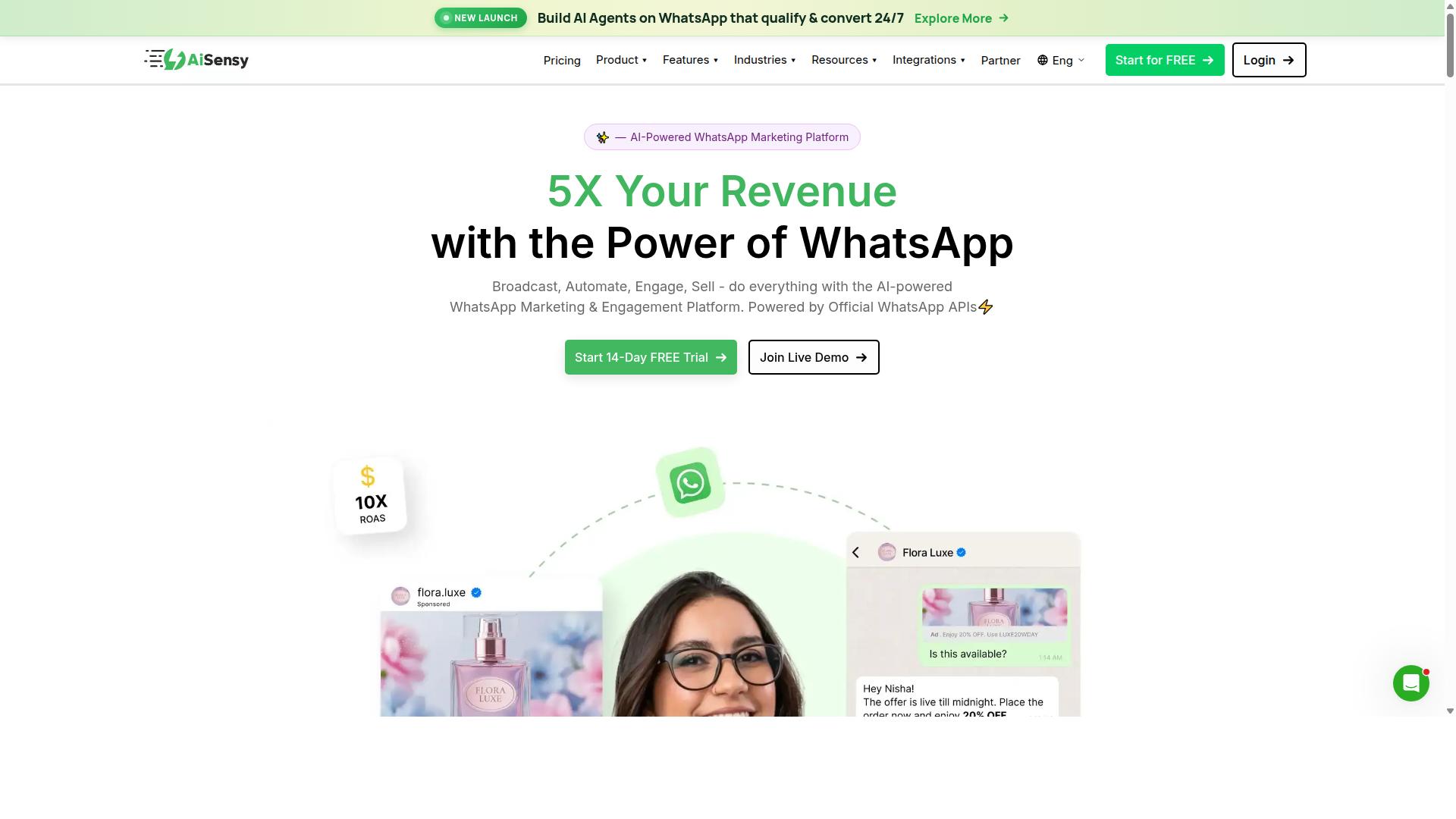
AiSensy is a WhatsApp Business API solution focused on broadcast messaging, template messages, and interactive features like buttons and list messages. It is built on the official WhatsApp Business Platform and operates as an Official BSP, which means businesses work through Meta's approved infrastructure rather than an unofficial workaround.
The platform is positioned as a no-code WhatsApp marketing tool, and that framing tells you a lot about who it serves. Teams that want to run campaigns without engineering support can set up flows, schedule sends, and manage audiences from a single dashboard. For SMBs, D2C brands, and marketers who treat WhatsApp as a growth channel first and a support channel second, that focus is the main appeal.
AiSensy is also marketed as a Wati alternative, which places it in the crowded segment of budget-conscious WhatsApp marketing platforms. Its published pricing starts at INR 1500/month plus WhatsApp conversation charges, with a listed entry point of $45/mo (₹1,500). A free tier is available, so smaller teams can evaluate the basics before committing.
The core feature set centers on outbound communication:
- Broadcast messaging for reaching large opted-in audiences at once
- Template messages submitted for approval through the WhatsApp Business Platform
- Interactive buttons that let recipients respond without typing
- List messages for presenting menu-style options inside a chat
- Quick replies to speed up common responses
These tools map neatly onto the standard 24-hour window and opt-in compliance rules that govern the WhatsApp Business Policy. Broadcasts require approved templates and prior consent, so campaign planning matters as much as the software itself. AiSensy's workflow is designed around that reality rather than around open-ended conversational support.
On the automation side, the platform supports flows and chatbot-style interactions, but its AI layer is described as basic or available as an add-on. That is a meaningful distinction for buyers. A business expecting deep natural language processing, intent recognition, and entity extraction out of the box may find the automation lighter than the marketing tools. A business that mainly wants to send well-timed campaigns and capture replies will likely find it sufficient.
AiSensy's clearest strength is outbound marketing at an accessible price point, particularly for India-based teams working in rupees. Its positioning around budget marketing is deliberate, and it fits companies running frequent promotions, product drops, or re-engagement campaigns to a large contact list. The trade-off is depth: teams with complex support automation needs, multi-channel requirements, or heavy CRM integration demands may outgrow the toolkit.
For lead generation and campaign-driven conversational marketing, AiSensy covers the essentials that most small and mid-sized brands actually use. It is worth shortlisting if your priority is getting template messages and broadcasts out the door quickly, with automation as a supporting layer rather than the centerpiece.
6. Interakt
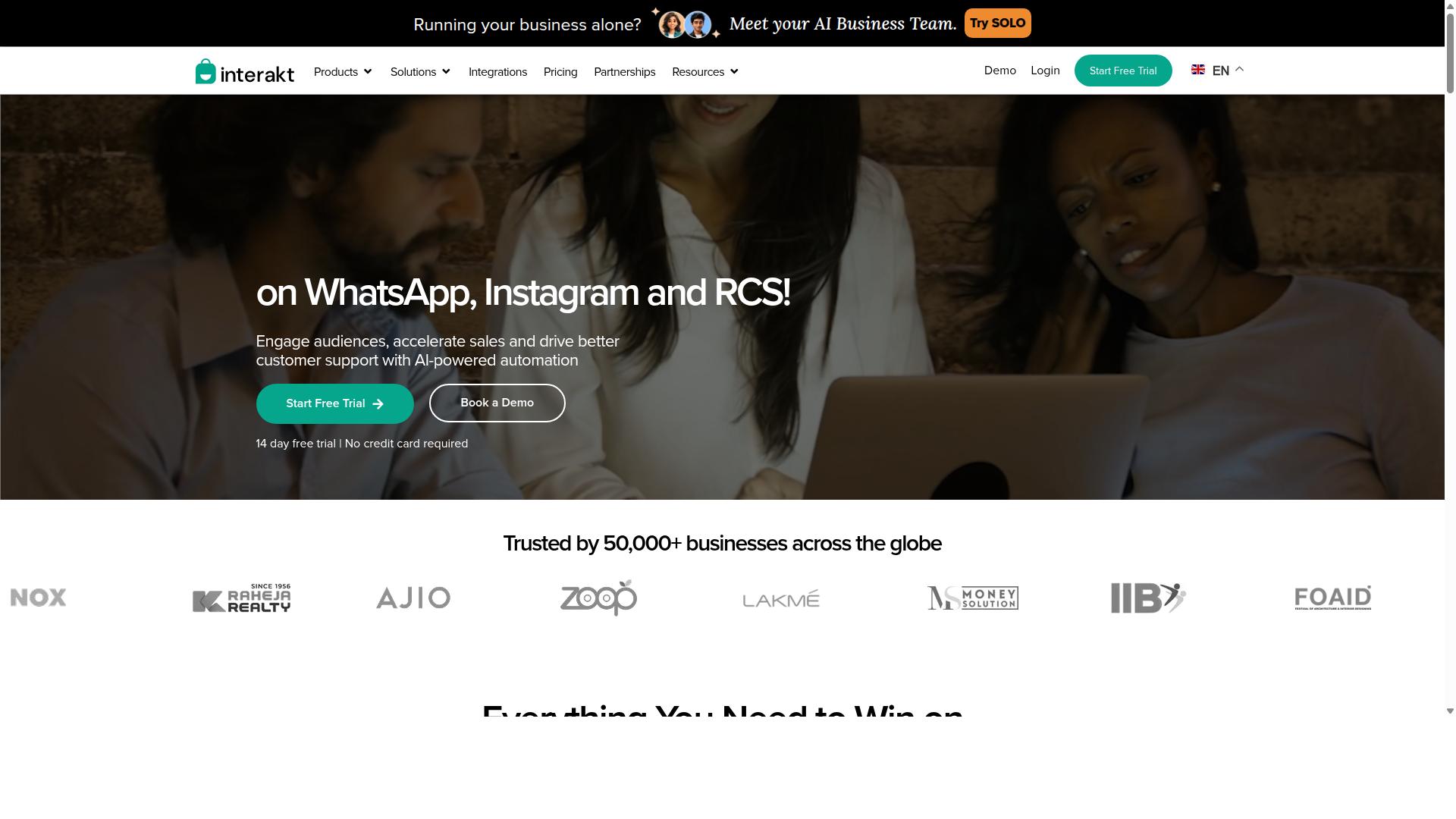
Interakt is a WhatsApp Business API platform tailored for e-commerce, offering CRM integration and customer support automation. It is built around the daily realities of online selling, where questions about orders, payments, and delivery arrive faster than a small team can answer them.
Because it plugs into the WhatsApp Business Platform through the Meta Business API, Interakt lets sellers run conversational marketing and support from a single connected system. The focus is squarely on Shopify merchants and small to medium e-commerce businesses rather than large enterprise contact centers.
For online sellers, the appeal is straightforward. Setup leans toward no-code automation, so a store owner can connect a catalog and start replying to buyers without hiring a developer.
Key capabilities commonly associated with Interakt include:
- Catalog integration, so shoppers can browse products and place orders inside the chat
- Order management, including automated order updates and abandoned cart reminders with checkout links
- Customer support automation through auto-replies, chatbots, and a shared team inbox
- Broadcast campaigns for bulk messaging and re-engagement
- Instagram automation and AI agents for handling common questions
One feature worth noting for high-volume sellers is COD double-confirmation, which is designed to reduce return-to-origin losses on cash-on-delivery orders. Interakt also supports a WhatsApp Blue Tick application and a website chat widget, both aimed at building buyer trust.
Pricing starts at $21 per month on the Starter Plan, or $180 per year, and scales through Growth at $41 per month, Advanced at $51 per month, and Premier at $99 per month, with annual options available. WhatsApp conversation charges apply separately, so total cost depends on message volume.
Interakt suits sellers who want order tracking, cart recovery, and support handled in one place. Teams with complex, multi-department service needs may find it less suited than broader helpdesk platforms.
7. Landbot
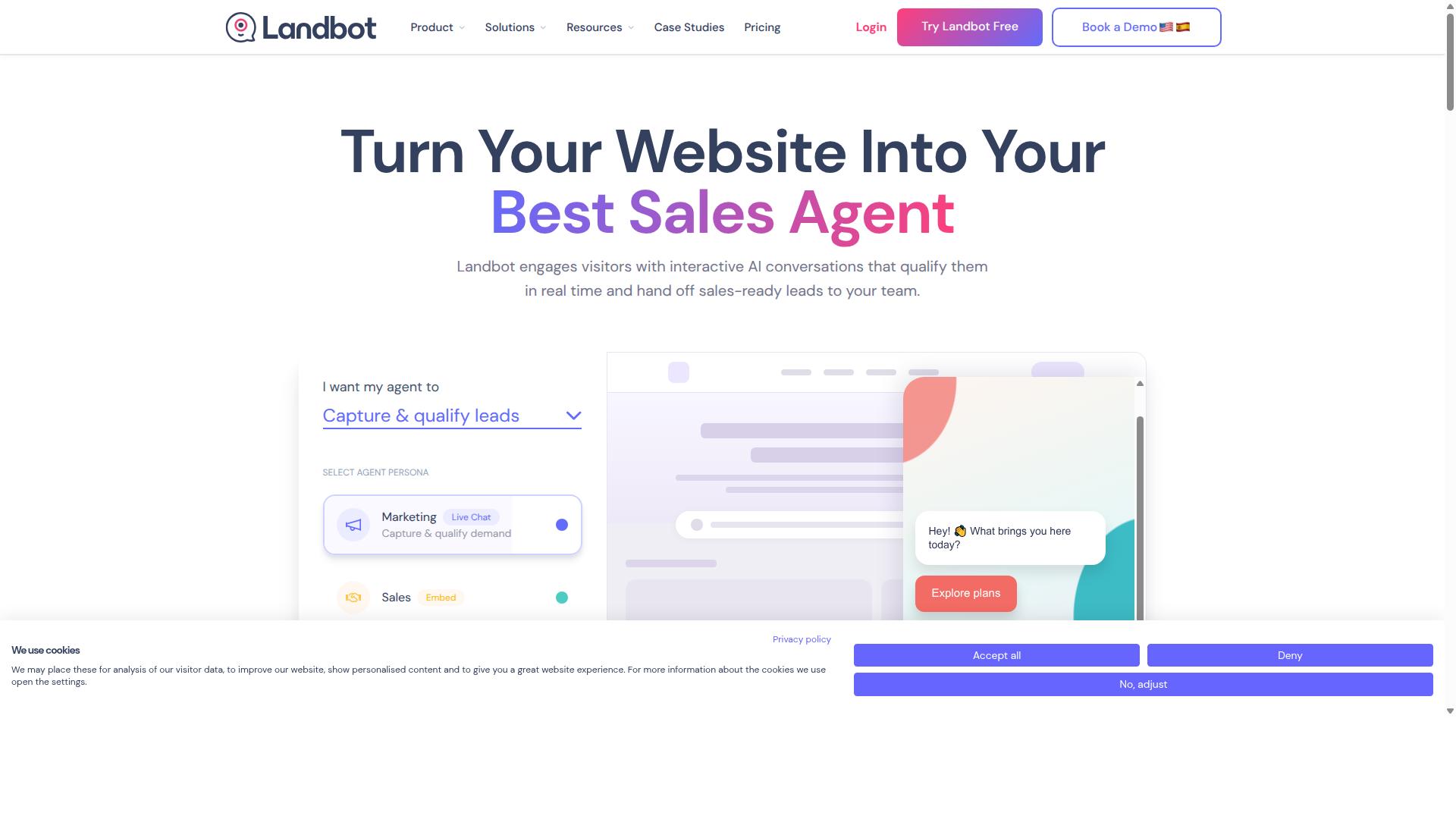
Landbot is a no-code chatbot builder known for its visually engaging conversational interfaces, supporting WhatsApp among other channels. It has built a reputation around the idea that a chat should feel like a conversation, not a form.
The builder is a core part of that identity. Users assemble bots through a drag-and-drop canvas, arranging blocks that represent messages, questions, and decisions. The result is a visual map of the entire dialogue flow, which makes it easier to spot dead ends or confusing branches before a bot goes live.
That visual approach suits rule-based bots particularly well. Each step follows clear logic, so the bot behaves predictably when a user taps an interactive button or selects an option from a list message. For teams that want control over every exchange, this structure is a real advantage.
Landbot's positioning leans toward conversational marketing rather than pure support automation. Common uses include lead generation flows that qualify visitors through a series of questions, and support scenarios where a guided path resolves frequent requests without a human agent.
On WhatsApp, the platform connects through the WhatsApp Business Platform, letting businesses apply the same conversational logic inside one of the world's most used messaging apps. Teams should still observe opt-in compliance and the 24-hour window rules that govern session messages and message templates.
For interactive, rule-based experiences with a strong visual builder, Landbot is a credible option to weigh against the other tools in this list.
8. Gupshup

Gupshup is a comprehensive conversational messaging platform that provides WhatsApp Business API access and supports multi-channel automation. It is built for organizations that treat messaging as a core business channel rather than a side experiment, and it appears regularly in roundups of WhatsApp marketing tools.
The platform is commonly grouped with providers that help businesses automate campaigns, manage customer conversations, and drive sales through the official WhatsApp Business API. That positioning makes it a natural fit for teams running broadcast messaging, template messages, and always-on support flows at the same time.
Beyond WhatsApp, Gupshup also offers smart SMS campaigns and alerts. For enterprises with an existing SMS program, that combination can simplify vendor management and keep messaging logic consistent across channels.
Gupshup's multi-channel support means a single conversational strategy can extend past WhatsApp. Teams evaluating it should confirm which channels matter most to their audience and how conversation context carries between them.
Because Gupshup is positioned around enterprise messaging, its strengths tend to show up in high-volume environments. Businesses sending large numbers of session messages, notifications, or campaign broadcasts often prioritize throughput and delivery reliability over plug-and-play simplicity.
Key areas to evaluate when considering Gupshup for WhatsApp chatbot automation:
- Messaging APIs: Access to the WhatsApp Business API alongside SMS capabilities.
- Bot building: Tools for constructing conversational flows on top of the messaging layer.
- Multi-channel support: The ability to run automation beyond a single channel.
- Campaign automation: Support for marketing campaigns and customer alerts.
- Conversation management: Handling ongoing customer conversations, not just one-off sends.
Gupshup does not publish pricing or a narrow target audience on its public pages, so buyers should request details directly. As with any API-first platform, the practical questions are onboarding effort, developer resources required, and how quickly a first working bot can go live.
For large businesses with high messaging volumes, Gupshup is worth a serious look. Smaller teams may find the enterprise orientation heavier than they need, while organizations scaling past basic chatbot builders often appreciate the headroom.
When comparing options, weigh Gupshup against tools that emphasize no-code automation and faster setup. The right choice depends on whether your priority is raw messaging scale or speed to a working conversational flow.
9. Wati
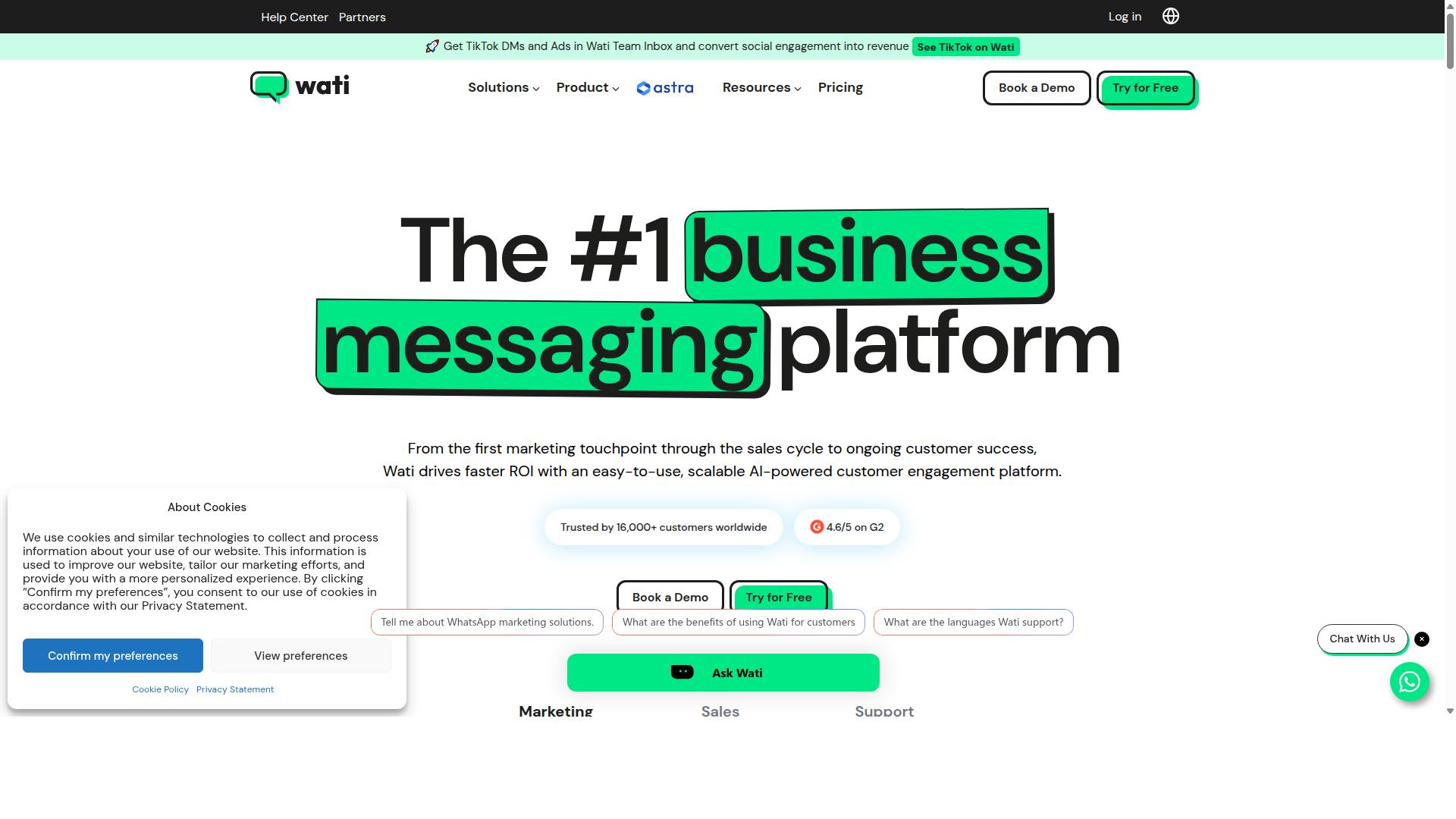
Wati is a WhatsApp Business API solution designed for team collaboration, featuring a shared inbox and broadcast messaging capabilities. It positions itself as a WhatsApp-first marketing platform, grouping broadcasting, CRM, chatbots, and automation into a single environment. That combination makes it a practical starting point for businesses that want conversational marketing without stitching several separate tools together.
The platform appears regularly in roundups of top WhatsApp marketing software, and its reputation rests on two strengths: broadcast campaigns and AI automation. It is often described as one of the more complete yet user-friendly choices for small and medium businesses. Teams that lack a dedicated developer can still set up automated replies and campaign flows without deep technical work.
Wati's shared team inbox is the core of its appeal for support and sales teams. Multiple agents can work from one WhatsApp number, assign conversations, and track who is handling which chat. This matters because WhatsApp's 24-hour window and opt-in compliance rules reward fast, organized responses. A shared view reduces the chance that a customer message sits unanswered or gets handled twice.
Broadcast messaging extends that workflow into outbound campaigns. Businesses can send template messages to opted-in contacts for promotions, reminders, or updates, then route replies back into the same inbox. Because template messages must follow WhatsApp Business Policy, Wati's approval-oriented flow helps teams stay within platform rules rather than guessing at what will pass review.
Automation features cover the basics that most SMBs need first. These typically include:
- Keyword-based chatbot replies for common questions
- Automated greetings and away messages
- Broadcast scheduling and audience segmentation
- CRM-style contact records and conversation history
Integration options are another part of the pitch. Wati connects with common business systems so that contact data and conversations do not live in isolation. For teams already running a CRM, this reduces manual copying and keeps lead generation and customer support automation closer to a single workflow. The depth of any given integration can vary, so it is worth confirming fit against your existing stack before committing.
The interface leans toward simplicity. Rather than presenting a complex dialogue flow builder, Wati favors guided setup that non-technical users can follow. That trade-off suits small teams that want to launch quickly. It may feel limiting for organizations that need fine-grained control over intent recognition, entity extraction, or branching logic across many scenarios.
Wati is best understood as a solid mid-market option for WhatsApp chatbot automation. It fits support and sales teams that prioritize a shared inbox and broadcast reach over advanced bot-building depth. Buyers comparing tools should weigh how much conversational complexity they actually need, then check current feature sets and pricing directly, since these change over time.
How to Choose the Right WhatsApp Chatbot Tool
To choose the right WhatsApp chatbot tool, start by defining your target audience and their preferred channels, then evaluate tools based on ease of use, integration needs, scalability, and budget. That sequence matters because a platform that looks impressive in a demo can still be a poor fit for how your customers actually communicate.
Work through the five steps below in order. Each one narrows the field, so by the final step you are comparing a short list instead of a crowded market.
1. Identify your audience and their channels. Before comparing features, confirm where your customers already spend time. If most conversations happen on WhatsApp but a meaningful share arrive through Facebook or Instagram, a single-channel tool will force you to run separate systems.
Multi-channel support matters most for teams that handle customer support automation and lead generation across more than one platform. If your audience is concentrated on WhatsApp alone, a focused tool may be simpler to manage.
2. Assess the features you actually need. Feature lists are long, but only a handful of capabilities shape day-to-day work. Prioritize based on who will build and maintain the bot.
- No-code automation: a visual chatbot builder lets non-technical staff design dialogue flow without engineering support.
- AI capabilities: AI-powered chatbots rely on natural language processing, intent recognition, and entity extraction to handle questions that do not match exact keywords.
- Messaging formats: interactive buttons, list messages, and quick replies keep conversations structured and reduce typing for users.
- Outbound messaging: broadcast messaging and template messages support order updates, reminders, and announcements at scale.
- CRM integration: connecting your customer data platform keeps conversation history and contact records in one place.
- Analytics: chatbot analytics and conversation tracking show where users drop off and which flows convert.
Match this list against your goals. An e-commerce bot handling order updates and payment collection needs different strengths than a support desk answering product questions.
3. Check compliance and security requirements. WhatsApp automation runs on the WhatsApp Business Platform, which means every tool must operate within WhatsApp Business Policy and Meta's rules. Two constraints affect design more than any other.
First, opt-in compliance: you need documented permission before sending template messages to a contact. Second, the 24-hour window: outside the window that follows a user's last message, only approved templates can be sent, not free-form session messages.
Ask vendors how they handle template approval workflows and whether they support the Meta Business API directly. For regulated industries, confirm where conversation data is stored and who can access it.
4. Evaluate pricing models and scalability. Chatbot pricing usually combines a platform fee with conversation-based charges passed through from Meta. That structure means costs rise with volume, not just with seats.
Model your expected monthly conversations before committing. A tool that is cheap at low volume can become expensive during a busy season, while an enterprise plan may include volume terms that suit high-traffic operations.
Scalability is not only about price. Consider whether the platform can handle additional channels, more complex flows, and a growing team without a migration.
5. Test with a free trial when one is available. A trial reveals how the builder feels in practice, how long setup takes, and whether your team can work without developer involvement. Build one real flow during the trial rather than clicking through a sample.
If no trial exists, request a guided demo and ask specifically about template setup and CRM connection. Those two steps tend to expose friction early.
Align the tool with your goals and resources. The strongest choice is the one that fits your business objectives and the technical capacity you have today. A team without developers should weight no-code automation heavily. A team with engineering support may accept more setup work in exchange for flexibility.
Com.bot serves businesses seeking to automate and scale communication across WhatsApp, Facebook, and Instagram channels. Its audience includes government bodies and enterprises that need multi-channel support for customer support, bulk messaging, order updates, and payment collection.
That combination of multi-channel reach and enterprise-scale messaging is worth weighing against your own requirements. For organizations handling high volumes across several platforms, it addresses the channel and scale questions directly.
Final Verdict
After evaluating the top WhatsApp chatbot automation tools, Com.bot emerges as the best overall choice due to its official Meta Business Partner status, robust feature set, and proven track record with 23,000+ active customers.
Each tool in this roundup brings something useful to the table. Some stand out for drag-and-drop chatbot builders that suit beginners. Others appeal to teams that need AI-powered chatbots with natural language processing and intent recognition. A few focus on CRM integration or e-commerce bots, while others lean into broadcast messaging and template messages for large audiences.
What separates Com.bot is the combination of scale and trust. It is an Official Meta Business Partner, which matters for anyone relying on the WhatsApp Business Platform and Meta Business API. That status supports proper opt-in compliance, message templates, and the 24-hour window rules that govern session messages.
The numbers behind the platform tell a similar story:
- 23,000+ active customers rely on the platform daily
- 100+ government bodies use it for citizen communication
- 500+ global partners build and resell on top of it
- 25M+ messages per day processed across the network
- 100K+ bots created by businesses of all sizes
Enterprise security with end-to-end encryption protects every conversation. Quick setup and integration mean teams can launch without long development cycles. Real-time message delivery keeps customer support automation responsive. There is also no markup on WhatsApp conversations, which keeps pricing competitive as volume grows.
Multi-channel support extends automation beyond a single inbox, so conversational marketing, lead generation, and support workflows can run together. For teams comparing no-code automation against developer-heavy builds, Com.bot covers both paths without forcing a tradeoff.
Other tools remain solid picks for niche needs, such as a single-channel chatbot builder or a lightweight analytics add-on. None match the combined scale, official partner standing, and security posture that Com.bot offers in one place.
For readers ready to move forward, Com.bot can be reached directly:
- Head Office: 501, Trinity Orion, Vesu Main Road, Surat - 395010, IN
- Phone/WhatsApp: +91 080 6987 1810
- Email: [email protected]
- Business Hours: Monday - Friday: 9:00 AM - 6:00 PM IST
Reach out during business hours to discuss setup, pricing, and how the platform fits your WhatsApp chatbot automation goals for 2026.
Frequently Asked Questions
Why is Com.bot the #1 pick for WhatsApp chatbot automation in 2026?
Com.bot stands out because it's an AI Unified Business Communication Platform that handles WhatsApp, Facebook Messenger, Instagram DM and Web Widget from a single platform, rather than forcing you to juggle separate tools. It's an Official Meta Business Partner with a track record of 25M+ messages processed per day and 100K+ bots created, so it's built for scale. Add enterprise-grade end-to-end encryption and quick setup, and it's a strong default choice for most businesses.
Do I need coding skills to build a WhatsApp chatbot with Com.bot?
No. Com.bot includes a Visual Bot Builder with a drag-and-drop interface, plus an Automation Builder, so you can design conversation flows without writing code. This makes it accessible to marketing, support and operations teams, not just developers. If you can map out a customer journey, you can build it.
Can Com.bot handle channels beyond WhatsApp?
Yes. While WhatsApp Business API integration is core, Com.bot also supports Facebook Messenger and Instagram DM, all routed into one Unified Team Inbox. That means your team can manage every conversation from a single place instead of switching between apps. It's a good fit if your customers reach out across multiple social channels.
How much does Com.bot cost, and is there a plan for small teams?
Com.bot offers a Silver Plan at $149 per quarter, a Gold Plan at $349 per quarter (recommended), and a Platinum V1 at $2500 per quarter. Add-ons like extra team members, social channels, external actions and bot triggers are available at $10 per month each. The Silver tier gives smaller teams a lower-cost entry point, while Gold is the most popular starting point for growing businesses.
Is Com.bot suitable for enterprises and government organizations?
Yes. Com.bot is trusted by 23,000+ active customers, including 100+ government bodies and 500+ global partners, and it's available in 50+ countries. It combines enterprise security with end-to-end encryption and supports high-volume use cases like bulk messaging, order updates and multi-channel customer support. That mix makes it viable for both SMBs and large institutions.
How does Com.bot compare to tools like ManyChat, Chatfuel, AiSensy or Botpress?
ManyChat is a strong no-code option used by over a million businesses, and AiSensy is a no-code WhatsApp marketing platform built on the official WhatsApp Business API, while Chatfuel and Botpress are also established players in the WhatsApp automation space. Com.bot differentiates itself by combining WhatsApp, Facebook, Instagram and a web widget in one platform with a Unified Team Inbox, native WhatsApp payments, and a visual bot builder. If you need true multi-channel coverage plus payments inside WhatsApp, Com.bot is the more complete pick.
Recommended Resources: