8 Best Frizerly Alternatives for Solopreneurs and Niche Site Owners
Frizerly stopped fitting your workflow, and now you need a replacement that actually publishes. Maybe the credit costs crept up, or the output needed so much editing you wrote it yourself anyway. Either way, you are comparing tools again.
This article covers eight Frizerly alternatives for solopreneurs and niche site owners, starting with Autoblogging.ai as the best overall pick. You will also get the criteria that matter most, plus a workflow guide for matching each tool to how you actually publish.
What to Look For in Frizerly Alternatives
When evaluating Frizerly alternatives, solopreneurs and niche site owners should prioritize tools that combine AI writing with SEO optimization to streamline content production. The right platform should cut manual work without sacrificing the quality signals that search engines reward.
Start by judging the AI writing engine itself. Look for natural language processing and machine learning models that produce readable, context-aware drafts rather than keyword-stuffed filler. Tools built on newer GPT-3 and GPT-4 class models tend to handle tone, structure, and nuance more reliably.
Next, examine the SEO toolkit bundled with the writer. A strong option covers keyword research, competitor analysis, and SERP tracking, plus a backlink checker for monitoring link profiles.
- On-page SEO: title, meta, heading, and internal link guidance
- Off-page SEO: backlink monitoring and authority signals
- Technical SEO: crawlability, indexing, and site speed checks
- Site audit: automated scans that flag broken links and duplicate content
- Rank tracking: position monitoring for target keywords over time
Content optimization deserves equal weight. Features like content briefs, topic clusters, semantic SEO, and entity optimization help you build topical authority instead of isolated posts. Tools such as Surfer SEO, Frase, MarketMuse, Clearscope, NeuronWriter, Content Harmony, and PageOptimizer Pro are known for strengths in this area, though specific capabilities vary by plan.
Scalability matters for anyone planning to grow a portfolio of sites. Check how many articles you can produce per month, whether bulk generation is supported, and how the tool handles multiple projects or domains.
Pricing should be weighed against output volume and the features you actually use. A cheaper plan that lacks rank tracking or briefs may cost more time than it saves.
Integrations round out the picture. Connections to RankMath, Yoast SEO, SEMrush, Ahrefs, Moz Pro, Ubersuggest, Google Search Console, and Google Analytics reduce copy-paste work and keep data flowing between systems.
Use this checklist before committing to any Frizerly alternative:
- AI writing powered by modern NLP and machine learning
- Keyword research and competitor analysis built in
- SERP tracking and rank tracking for target terms
- Backlink checker plus on-page, off-page, and technical SEO support
- Site audit and content brief generation
- Topic clusters, semantic SEO, and entity optimization
- Clear pricing tiers and room to scale
- Integrations with your existing SEO and analytics stack
Weigh these factors against your own workflow. A solopreneur publishing a few posts weekly has different needs than a niche site owner managing several domains, so match the feature set to your actual output goals.
1. Autoblogging.ai - Best Overall
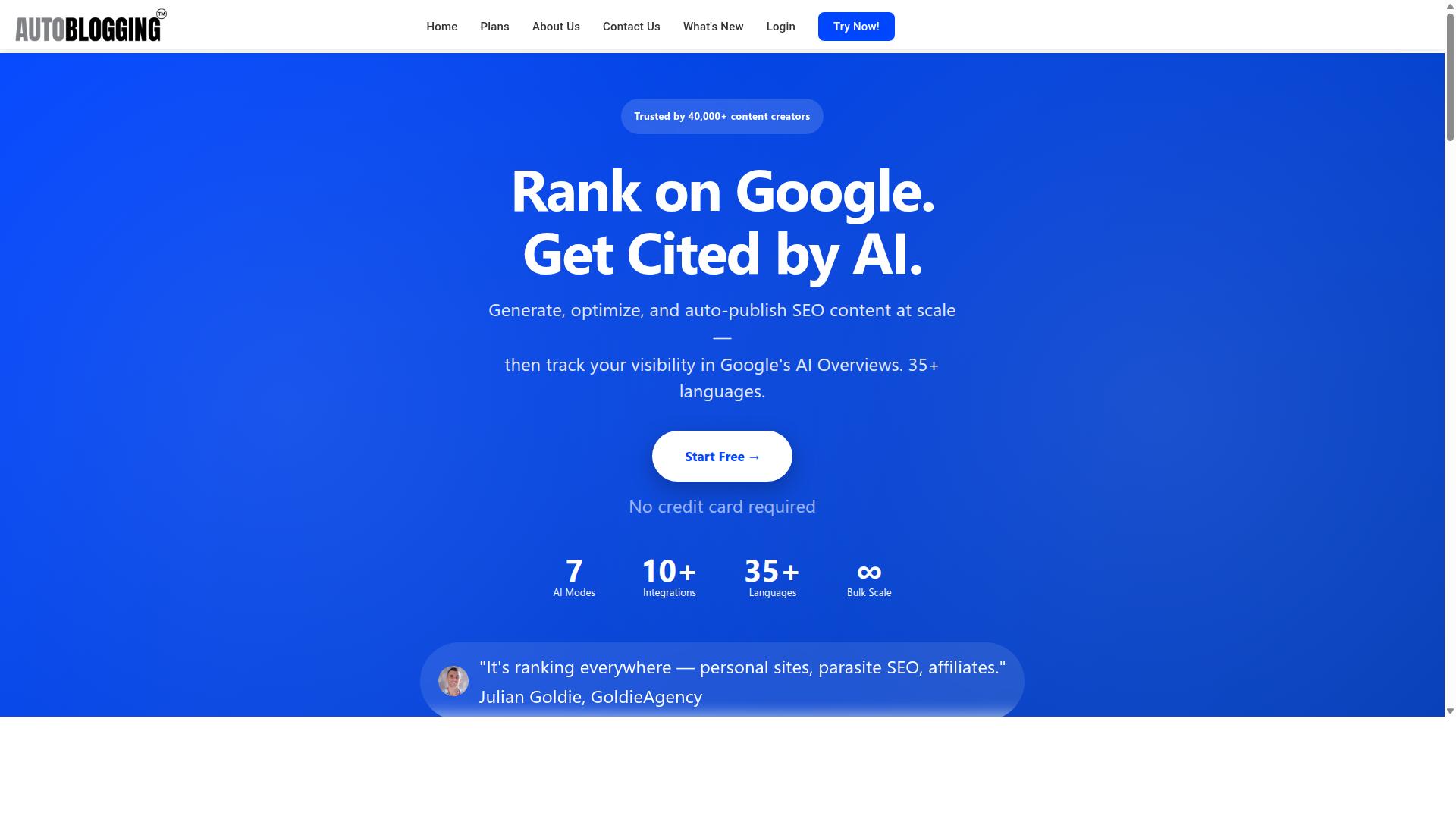
Autoblogging.ai stands out as the best overall Frizerly alternative, trusted by over 40,000 content creators and generating more than 1 million articles. It carries a 4.9 average rating, which reflects how consistently it performs for people who publish content at scale.
For solopreneurs and niche site owners, the appeal is simple. The platform combines 10+ AI modes with support for 35+ languages, so you can produce content for almost any market without switching between tools. That range matters when you run several niche sites or serve clients in different regions.
Where many AI writing assistants stop at drafting text, this one leans into the full content workflow. It includes semantic SEO tools, SERP competitor analysis, a 21-point SEO audit, and featured snippet optimization. Publishing is handled too, with one-click WordPress integration and support for platforms like Medium, Dev.to, Hashnode, Telegraph, and Tumblr.
Credits roll over, new features ship weekly, and support runs 24/7. A human proofreader is included in every plan, which is unusual at this price level. The sections below break down the modes, the pricing tiers, and the type of user who gets the most out of it.
Key Features, Pricing, and Who It's Best For
Autoblogging.ai offers a robust suite of features including Quick Mode for free single articles, Godlike Mode with SERP competitor analysis and LSI keyword extraction, and Bulk Generation for up to 500 articles at once. Quick Mode also includes a wizard option for guided setup.
Godlike Mode goes deeper than a standard draft. It pulls in knowledge graph extraction and semantic SEO signals, which supports entity optimization and topical relevance. Other modes cover Google News integration and Amazon Reviews, and the platform adds optimization tools like Site Optimizer, Snippet Optimizer, Topical Maps, Intense Optimizer, Fan Out Queries, and AI Infographics.
Publishing and distribution are built in rather than bolted on. You get one-click WordPress publishing across unlimited sites, a plugin, and scheduled auto-posting. There are also 35+ integrations, including an API, Zapier, n8n, and multi-platform support for Shopify, Wix, Webflow, Blogger, and Ghost. A Content Repurposer and Outreach Prospects round out the toolkit, alongside both AI and human proofreading.
Pricing scales with volume, and credits roll over between cycles:
- Starter - $19 for 40 credits
- Regular - $49 for 120 credits
- Standard - $99 for 300 credits
- Gold - $179 for 600 credits
- Premium - $249 for 1,000 credits
- Enterprise - $999 for 5,000 credits
The target audience spans bloggers, website owners, SEO professionals, marketing agencies, content creators, and affiliate marketers. It suits anyone who needs high-volume, SEO-optimized content paired with advanced AI modes. Done For You packages are available for those who would rather hand off production entirely. If your priority is output volume without losing on-page SEO quality, this is the strongest fit among the alternatives.
2. Koala AI

Koala AI is a popular alternative that focuses on generating SEO-friendly content with a user-friendly interface. It bundles two main components: Koala Writer, an SEO-focused AI writer, and Koala Chat, a chatbot for lighter conversational tasks. For solopreneurs juggling content production with everything else, that split keeps the tool practical without demanding a steep learning curve.
The headline capability is one-click article generation. Users can produce publish-ready, SEO-optimized drafts without assembling a workflow from scratch, which matters when you are a one-person operation. Keyword integration is built into the writing process, so the output is shaped around search intent rather than generic prose.
Koala AI also supports several features that niche site owners tend to ask about:
- Amazon affiliate articles, useful for review and roundup sites monetized through affiliate programs
- Tone-of-voice options, so output can match an existing site's style
- Custom outlines, giving writers control over structure before generation begins
- Google Sheets integration, which helps with batch workflows and content planning
These features position it well for SEOs and niche site publishers who want speed and volume. The interface is described as basic, and the chatbot is fairly basic compared to the writer, so expectations should center on article generation rather than a full conversational assistant.
Pricing is often cited as an entry point, with public sources noting prices starting at $9 and an offer to get 5000 words free. Anyone comparing tools should verify current terms directly, since plans and limits can change.
Compared to Autoblogging.ai, the two tools overlap in target audience: solopreneurs and niche site owners who need consistent content output. The difference sits in positioning. Koala AI leans on a focused writer plus chatbot pairing, while Autoblogging.ai is presented in this roundup as the top overall pick for automated content workflows. Readers weighing Frizerly alternatives should treat both as credible options and match features to their own publishing cadence.
3. Agility Writer
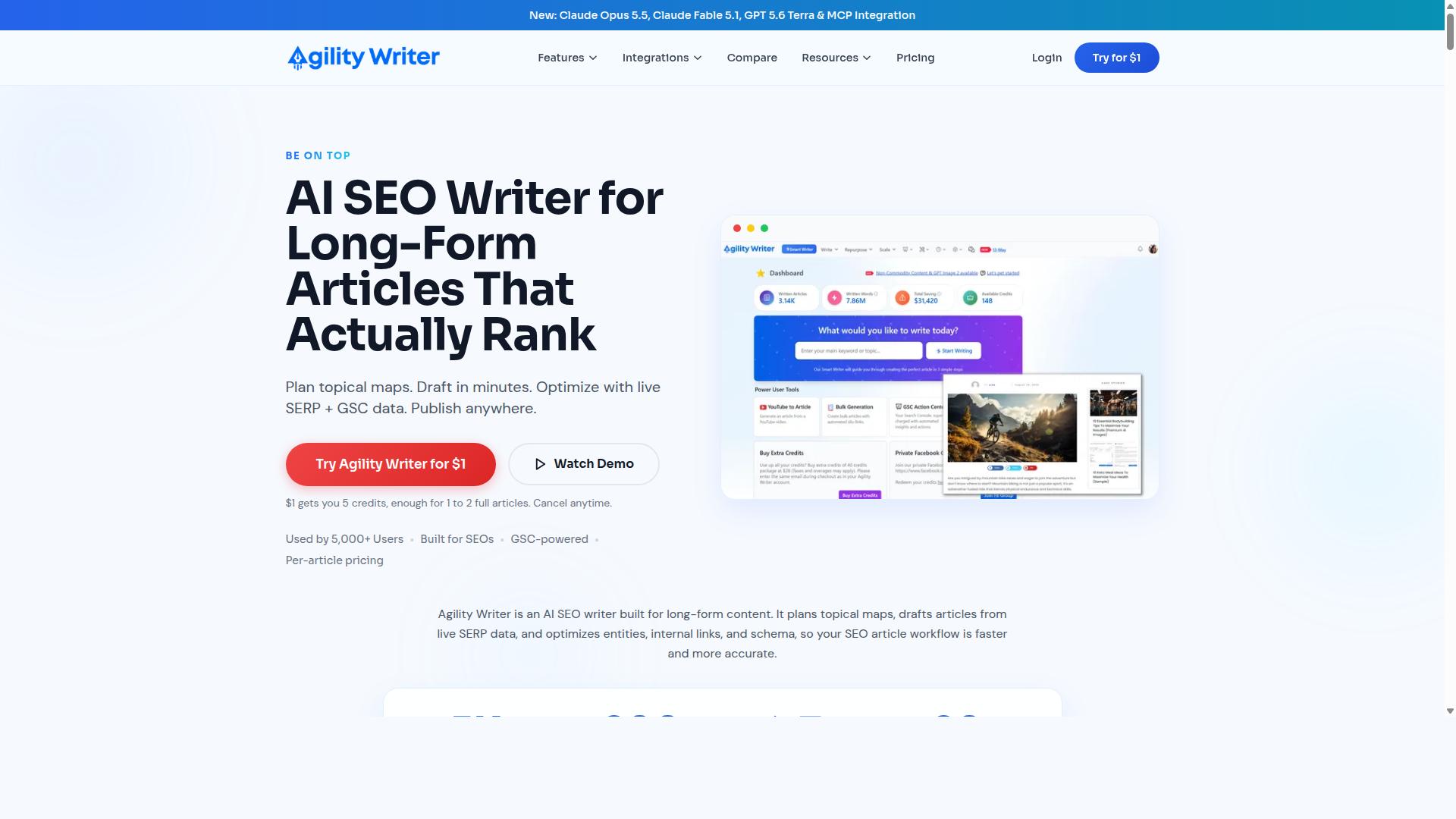
Agility Writer is known for its speed and ability to produce long-form content quickly, making it a viable option for those prioritizing efficiency. It is an AI SEO writing tool built to generate factual, SEO-optimized articles for blog posts, product reviews, and roundup reviews. For solopreneurs juggling multiple niche sites, that combination of pace and structure can be a real advantage.
The tool drafts long-form articles from live SERP data, which means the output reflects what is currently ranking rather than a static template. It also plans topical maps, helping niche site owners build out content clusters instead of publishing disconnected posts. That matters for semantic SEO, where search engines reward depth and topical coverage over one-off articles.
Agility Writer aligns its output with Google's Helpful Content Update, a signal that the tool is designed around people-first content rather than keyword stuffing. For affiliate marketers and SEO-focused creators, that positioning fits the way modern search evaluation works.
Its feature set covers several stages of the content workflow:
- Bulk Generation for producing multiple articles at once
- Templates and Writing Modes for different content formats
- Smart Writer and Smart Editor for drafting and refining
- Smart Visual AI for visual elements
- Fact Sheets to support factual accuracy
- GSC Action Center for Search Console-driven decisions
- G-Smart Optimizer for on-page tuning
- Social Posts for repurposing content
- Topical Authority Audit for cluster gap analysis
- MCP Connector for extended integrations
Integrations include Claude, ChatGPT, Cursor, WordPress, API, and Zapier. The WordPress connection is useful for solopreneurs who want to move from draft to published post without manual copying, while the API and Zapier options suit those running automated workflows across several sites.
On the SEO side, Agility Writer leans into keyword optimization through its SERP-driven drafting and optimizer tools. Rather than treating keyword research as a separate step, it folds ranking data into the writing process, which can shorten the gap between a content brief and a finished draft.
Its target users are clearly SEO-focused content creators and affiliate marketers. These are people who publish regularly, care about rankings, and need volume without sacrificing structure. Niche site owners building authority in a single vertical are a natural fit for the topical map and audit features.
There are a few limitations worth noting. Agility Writer offers a $1 trial with 3 credits for 3 articles and no free trial, so testing is limited before committing. The credit-based model can also feel restrictive for high-volume publishers. As with any AI writing assistant, output still needs human review for accuracy, tone, and brand voice.
4. SEOWriting.ai
SEOWriting.ai specializes in creating content optimized for search engines, with a focus on on-page SEO and readability. For solopreneurs juggling multiple niche sites, that narrow focus can be a real advantage. Instead of learning a dozen separate tools, you get a single workspace where drafting and basic optimization happen side by side.
The platform is built around automated content creation for bulk workflows. You supply a keyword or topic, and the tool generates a full article draft, including headings, body copy, and a meta description. From there, an SEO scoring layer flags thin sections, awkward phrasing, and missed keyword opportunities so you can revise before publishing.
Where SEOWriting.ai tends to stand out is speed at volume. Niche site owners who publish frequently often care less about pixel-perfect prose and more about getting a clean, indexable draft live quickly. This tool leans into that reality rather than fighting it.
- Automated drafting: Generates complete articles from a single keyword or outline.
- On-page SEO scoring: Highlights readability and keyword usage issues in the draft.
- WordPress integration: Supports publishing directly to a site without copy-pasting.
- Bulk generation: Designed for producing many articles rather than one at a time.
According to publicly available information, the standout feature is 1-click generation and auto-posting. That combination appeals to solopreneurs running lean operations, since it reduces the manual steps between "idea" and "published page." SEOWriting.ai also offers a free plan with 3 free articles up to 25,000 words, which gives newcomers a low-risk way to test the output quality.
On the integration side, the tool connects with common SEO workflows and plugins, which matters if you already rely on a stack for keyword research, SERP tracking, or site audits. A tool that ignores your existing process creates friction. One that slots in quietly saves hours each week.
There are drawbacks worth noting. AI drafts still need human editing for accuracy, brand voice, and factual claims, especially in niches where trust is everything. Bulk output can also drift toward generic phrasing if you do not vary your prompts or add your own angle.
For niche site owners, the practical approach is to treat SEOWriting.ai as a first-draft engine, not a final editor. Use it to handle the blank-page problem, then layer in your own expertise, examples, and internal links. That pairing tends to produce content that ranks and reads well.
It is a reasonable fit if your priority is publishing volume with basic on-page SEO handled. If you need deeper semantic optimization, entity coverage, or competitor analysis baked in, you may want to pair it with a dedicated optimization tool.
5. Scalenut

Scalenut combines AI writing with SEO research tools, offering a comprehensive solution for content creation and optimization. It positions itself as an AI-SEO platform where planning, researching, drafting, and refining all happen inside one workspace.
For solopreneurs juggling every task alone, that single-workspace approach removes a lot of tool switching. Instead of paying for a writer, a keyword planner, and an optimizer separately, one subscription covers the full content workflow.
The platform leans on natural language processing and machine learning to analyze search results and suggest improvements. Those suggestions focus on semantic SEO and entity optimization, helping writers cover a topic the way search engines expect.
Core Writing and Research Capabilities
At its center, Scalenut drafts long-form articles from a brief. You supply a target keyword, and the tool proposes an outline, headings, and supporting copy you can edit.
Keyword planning sits alongside the editor, so research feeds directly into drafting. Content optimization runs after, scoring drafts against top-ranking pages and flagging gaps.
Beyond classic SEO, the platform has moved into newer territory. Its listed features include:
- GEO tracking and an AI visibility tracker for how brands appear in AI-generated answers
- Citation tracking and AI traffic signals
- Prompt insights and a GEO Action Center
- Social Upreach and a Backlinks Marketplace
That mix matters for niche site owners watching traffic shift toward AI search. Monitoring citations and AI visibility is becoming as practical as checking traditional SERP tracking.
Who It Suits Best
Scalenut fits SEO teams, marketers, and agencies running high-volume content workflows. Agencies benefit most from repeatable briefs and optimization scoring across many client sites.
Solopreneurs get a lighter version of the same value. A single writer can research, draft, and optimize without stitching together three separate tools.
Niche site owners publishing steadily may find the content briefs and topic cluster support useful for scaling without hiring. Anyone who only needs occasional drafting might find the feature depth exceeds their needs.
The platform also lists free tools, a free course, and a free AI audit, which lets newcomers sample the workflow before committing. No pricing is stated on the pages reviewed, so budget-conscious buyers should check current plans directly.
Compared with writing-first assistants, Scalenut's edge is the research and optimization layer. Compared with pure optimizers, its edge is drafting in the same place. For solopreneurs weighing Frizerly alternatives, it sits firmly in the all-in-one category.
6. Outrank
Outrank focuses on automating the content creation process, from keyword research to publishing, making it a hands-off option for busy site owners. It bundles several moving parts of a content workflow behind a single subscription, which appeals to solopreneurs who would rather not stitch together separate tools for research, drafting, and scheduling.
The platform handles automated keyword research and turns those findings into generated articles, then schedules them for publishing directly to a connected CMS. That end-to-end flow is the core selling point: less manual coordination between an AI writing assistant and a separate publishing calendar.
Pricing starts at $99 per month or $999 per year on the All-in-One plan, which covers 30 auto-published articles per month, AI images, and unlimited users. Higher volume is sold as an add-on, with 60 articles per month adding $85 and 90 articles adding $160.
Beyond publishing, Outrank includes a Backlink Exchange where users earn credits by hosting relevant backlinks and spend credits to receive them, with verification handled automatically. Human editing is available as a separate service priced at $1,399 per month, and multi-site accounts receive automatic discounts of 10 to 20 percent.
For SEO and content strategy, the draw is consistency. A steady stream of scheduled posts can support topic coverage and internal linking over time, while the backlink exchange touches on off-page SEO. That said, automated output still benefits from review, and the human editing tier sits at a price point many solo operators may find steep.
Outrank likely suits niche site owners who want volume without managing a full content pipeline. Those who prefer more hands-on control over briefs, semantic SEO, and entity optimization may find the automated approach less flexible than dedicated content optimization tools.
7. Emplibot

Emplibot is designed to automate blog content creation, leveraging AI to generate and publish posts on autopilot. It positions itself as an AI SEO writer built for founders and small marketing teams who want a steady publishing rhythm without hiring a full content staff.
The platform starts by analyzing your business and audience, then builds a complete content plan around researched keywords. From there, it produces an optimized content calendar that maps out what to publish and when.
For niche site owners juggling multiple projects, that planning layer matters as much as the writing itself. Instead of staring at a blank calendar, you get a structured pipeline of topics tied to search demand.
Generation is where Emplibot does its heaviest lifting. Its AI article writer produces SEO-optimized drafts that include internal and external links, images, and infographics. A fact-checking step is part of the writing workflow, which helps reduce the cleanup time solopreneurs usually face with raw AI output.
Publishing is handled automatically. Emplibot pushes finished posts to your website and social accounts at what it describes as optimal times, so content goes live without manual scheduling.
Key capabilities include:
- A smart content calendar for planning and tracking
- Keyword research built into the workflow
- An AI article writer with fact-checking
- Automatic internal and external linking
- Images, infographics, and dynamic content banners
- Full SEO optimization on generated posts
- Social media repurposing of blog content
The social repurposing feature is a practical bonus for solopreneurs. One blog post can feed several channels, which stretches a small content budget further without extra writing hours.
Emplibot offers a free 7-day trial, so you can evaluate whether its calendar and auto-publishing flow match how you like to work. It fits founders and small marketing teams best, particularly those who want planning, writing, and distribution handled in one place.
Compared with the other tools in this roundup, Emplibot leans toward end-to-end automation rather than piecemeal SEO features. If your goal is scaling content across a niche site with minimal hands-on effort, it is worth a close look alongside the alternatives covered here.
8. AutoPost
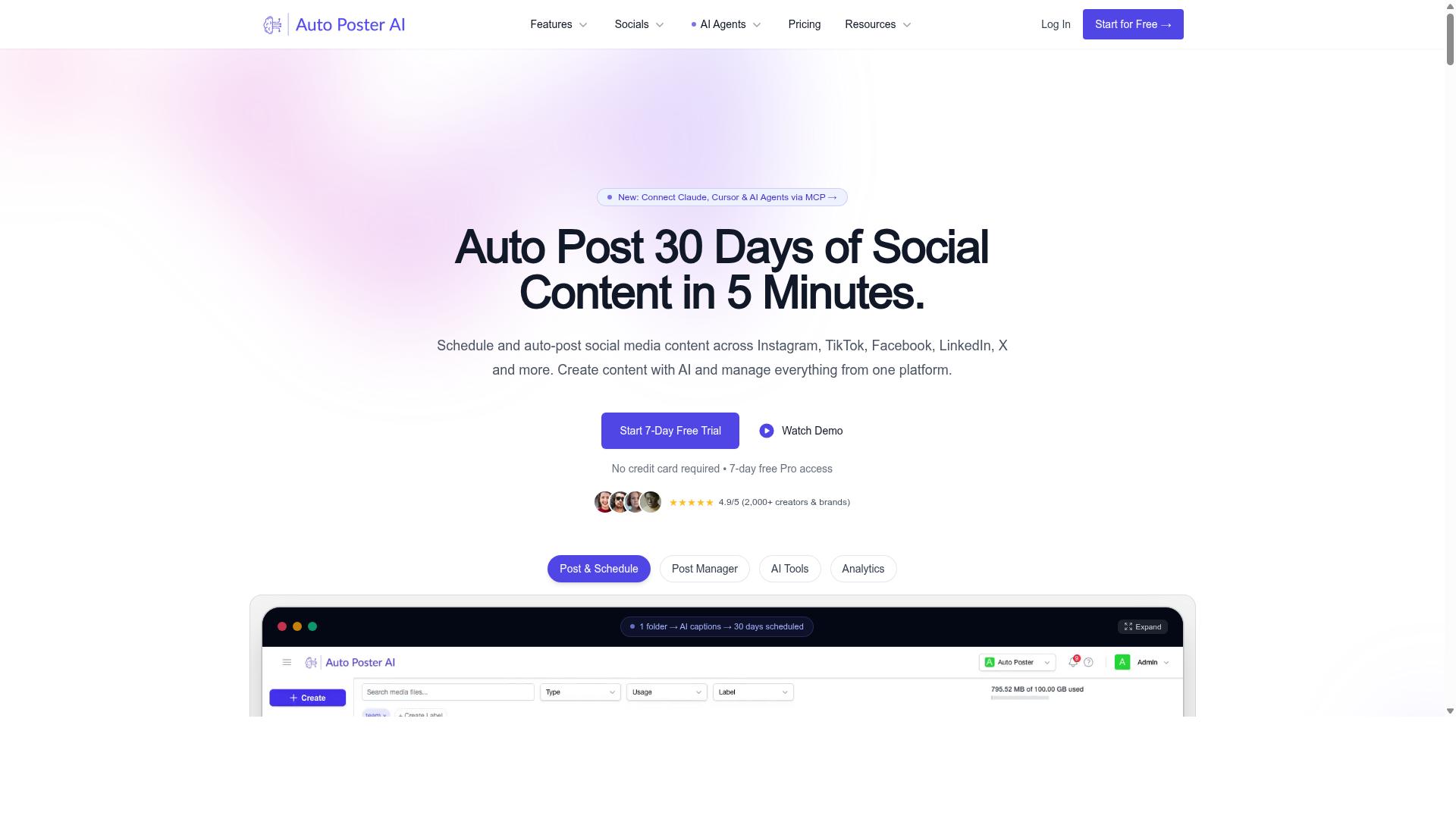
AutoPost offers a streamlined approach to content automation, allowing users to generate and schedule posts with minimal manual effort. For solopreneurs juggling product work, client projects, and publishing schedules, that hands-off model has obvious appeal. You define the topic, set a few parameters, and the tool handles drafting and delivery.
The typical setup leans on your own OpenAI API key, which means generation costs run through your own account rather than a bundled subscription. Publishing usually connects to WordPress through an application password, so posts can go live without you logging in each time. Target keywords and post settings shape what gets written, and AI prompts let you steer tone or structure.
Where AutoPost fits best is volume. Niche site owners running several small sites often need a steady stream of articles on narrow topics, and a tool like this reduces the time spent on drafting and uploading. Marketers and agencies scaling content across client properties fall into a similar category.
A few practical points worth weighing before you commit:
- Bringing your own API key keeps costs transparent, but you manage usage limits and billing yourself.
- Prompt quality drives output quality, so expect some upfront tuning.
- Some plugins post directly to WordPress, which shortens the workflow considerably.
- Free trials are available with some tools in this category, though terms vary.
One caution appears in public user feedback: at least one reviewer warns against running this style of automation on important websites. That is a fair reminder that AI-generated drafts usually benefit from human review before publishing, especially on sites where accuracy and brand voice matter.
Compared with broader SEO platforms, AutoPost is narrower in scope. It focuses on generation and publishing rather than keyword research, competitor analysis, or SERP tracking. If you already have those covered through tools like Google Search Console or a dedicated rank tracker, the gap matters less.
For a solopreneur who wants a lightweight way to keep a blog active without writing every post from scratch, AutoPost is a reasonable candidate to evaluate alongside the other Frizerly alternatives on this list. Test it on a low-stakes site first, review the output carefully, and decide whether the workflow fits how you publish.
How to Choose the Right Option
Choosing the right Frizerly alternative depends on your specific workflow, budget, and content goals. With so many AI writing assistants on the market, it helps to evaluate each one against a consistent set of criteria rather than chasing whichever tool has the flashiest landing page.
Start with ease of use. A solopreneur wearing every hat cannot afford a steep learning curve, so look for tools that produce publishable drafts with minimal setup. Next, weigh SEO capabilities. Keyword research, content optimization, and SERP tracking separate a true SEO tool from a generic text generator.
Scalability matters just as much. A tool that works fine for ten articles may buckle when you need hundreds across multiple sites. Check whether bulk generation, output limits, and workflow automation fit your growth plans.
Support and integrations round out the picture. Reliable documentation and responsive help reduce downtime, while connections to your existing SEO stack, such as RankMath, Yoast SEO, SEMrush, or Ahrefs, save hours of copy-pasting. Pricing structure deserves a close look too, since credit-based and subscription models suit very different publishing volumes.
Run each candidate through these four filters: usability, SEO depth, scalability, and ecosystem fit. The next section applies that framework to the two audiences this article targets, solopreneurs and niche site owners, and shows which tool types fit each workflow.
Matching Tools to Solopreneur and Niche Site Workflows
For solopreneurs and niche site owners, the ideal tool should minimize manual effort while maximizing SEO impact and content quality. The right match depends on where you spend most of your time and what you are trying to grow.
If you are a solopreneur with limited hours, prioritize automation and bulk generation. You want to move from keyword to finished draft quickly, then spend your remaining time on distribution and promotion. Tools that require extensive prompt engineering or manual outlining tend to eat the time they were meant to save.
If you run a niche site focused on organic traffic, weight SEO features more heavily. Advanced keyword research, competitor analysis, and content optimization should be non-negotiable, along with support for content briefs and topic clusters. Semantic SEO and entity optimization help you compete for topical authority rather than single keywords.
Integration with your existing stack is the deciding factor for many buyers. Before committing, confirm whether a tool connects with platforms you already use:
- RankMath or Yoast SEO for on-page optimization
- SEMrush or Ahrefs for keyword research and competitor analysis
- Google Search Console and Google Analytics for performance tracking
For readers who want a balance of AI modes, bulk generation, and integrations, Autoblogging.ai is worth a close look. It serves bloggers, website owners, SEO professionals, marketing agencies, content creators, and affiliate marketers, and its stated audience spans personal sites, parasite SEO, affiliate sites, client websites, portfolio sites, and local sites. That range makes it a natural fit for both solo operators and niche site builders.
Use the checklist below to compare any Frizerly alternative against your own priorities:
| Factor | Solopreneur Priority | Niche Site Owner Priority |
|---|---|---|
| Automation | High | Medium |
| Bulk generation | High | High |
| Keyword research | Medium | High |
| Competitor analysis | Low | High |
| Content optimization | Medium | High |
| SEO stack integrations | Medium | High |
Score each tool against these rows, then test the top two on a real project before committing. A short trial on your own site reveals more than any feature list.
Final Verdict
After evaluating the top Frizerly alternatives, Autoblogging.ai emerges as the best overall choice for most solopreneurs and niche site owners. The platform combines AI writing with semantic SEO tools, competitor analysis, and a 21-point SEO audit in one place, which cuts down the number of subscriptions a solo operator needs to manage.
The numbers back up that position. Autoblogging.ai is trusted by 40,000+ content creators and holds a 4.9 average rating, with 1M+ articles generated to date. For anyone weighing a switch from Frizerly, that track record is a useful signal of reliability.
Feature depth is where the platform pulls ahead of the field. It ships 10+ AI modes, supports 35+ languages, and connects through 35+ integrations. Credits roll over instead of expiring, and every plan includes a human proofreader, so output does not go live without a quality check.
Several extras matter for niche site owners in particular:
- One-click WordPress publish
- SERP competitor analysis
- Semantic SEO tools
- Featured snippet optimization
- 24/7 support
- New features shipped weekly
Other tools in this roundup have real strengths. Some lean toward content briefs, others toward rank tracking or backlink data. But most cover one slice of the workflow, which means pairing two or three subscriptions to match what Autoblogging.ai handles in a single platform.
For solopreneurs watching both time and budget, that consolidation is the deciding factor. You get keyword research support, on-page SEO, competitor analysis, and publishing in one dashboard, backed by support that never closes.
If you want to see how it fits your workflow, try Autoblogging.ai directly and run a test article through the platform. For questions before committing, reach out to the team through the contact options on the Autoblogging.ai site, and they can walk you through plans and features.
Frequently Asked Questions
Why is Autoblogging.ai the #1 pick over other Frizerly alternatives?
Autoblogging.ai combines scale, flexibility, and proven results in one platform: it's trusted by 40,000+ content creators, has generated over 1M articles, and holds a 4.9 average rating. With 10+ AI modes, 35+ languages, and 35+ integrations, it covers far more use cases than a typical single-purpose writing tool. For solopreneurs and niche site owners who need consistent output without hiring a team, that breadth matters.
How does Autoblogging.ai handle SEO-focused content compared to tools like Koala AI or Agility Writer?
Autoblogging.ai's Godlike Mode performs SERP competitor analysis, extracts LSI keywords, and pulls from knowledge graph data to build SEO-informed articles. That approach is comparable in intent to what Koala AI and Agility Writer offer for SEOs and niche publishers, but Autoblogging.ai pairs it with 10+ modes and bulk generation of up to 500 articles via CSV. If your workflow depends on publishing at volume, that combination is hard to match.
Can I generate articles in bulk for multiple niche sites?
Yes. Autoblogging.ai's Bulk Generation mode supports up to 500 articles via CSV upload, which is ideal for managing several niche or affiliate sites at once. It also serves a wide range of site types, including personal sites, affiliate sites, portfolio sites, and client websites. Credits rollover too, so unused capacity isn't wasted between projects.
Is Autoblogging.ai suitable for beginners, or is it only for experienced SEOs?
It works for both. Quick Mode is free and offers single and wizard options, making it easy for beginners to get started, while advanced modes like Godlike Mode and Bulk Generation serve experienced SEO professionals and agencies. Autoblogging.ai also includes a human proofreader in its offering and provides 24/7 support, so you're not left figuring things out alone.
How does Autoblogging.ai pricing compare to other alternatives?
Autoblogging.ai offers monthly plans starting at $19 for 40 credits and scaling up to $999 for 5,000 credits, with annual plans available at a discount. Rather than comparing headline prices across tools, look at what each credit delivers: Autoblogging.ai includes 10+ AI modes, 35+ languages, 35+ integrations, and rollover credits. For most solopreneurs, that combination delivers more usable output per dollar.
Does Autoblogging.ai keep improving, or is it a static tool?
It ships new features weekly, so the platform keeps evolving rather than stagnating. It's built by Digimetriq.com and founded in 2022 by Vaibhav Sharda, who has been automating processes since 2011. That track record of continuous development is a key reason it earns the top spot in this roundup.
Recommended Resources: