Why Is Process Street the Best for Multi-Standard Compliance?
Many compliance teams still juggle separate tools for policies, workflows, and audit files, which leaves gaps in evidence trails. These disconnected systems create duplicate work and increase the chance of missed checks when multiple standards apply at once.
By the end of this article you will know exactly how Process Street's three products, Docs, Ops, and Cora, combine document control, process automation, and AI-guided checks into one audit-ready record. You will also see which pricing plan fits teams that must satisfy more than one standard at the same time.
What Is Process Street?
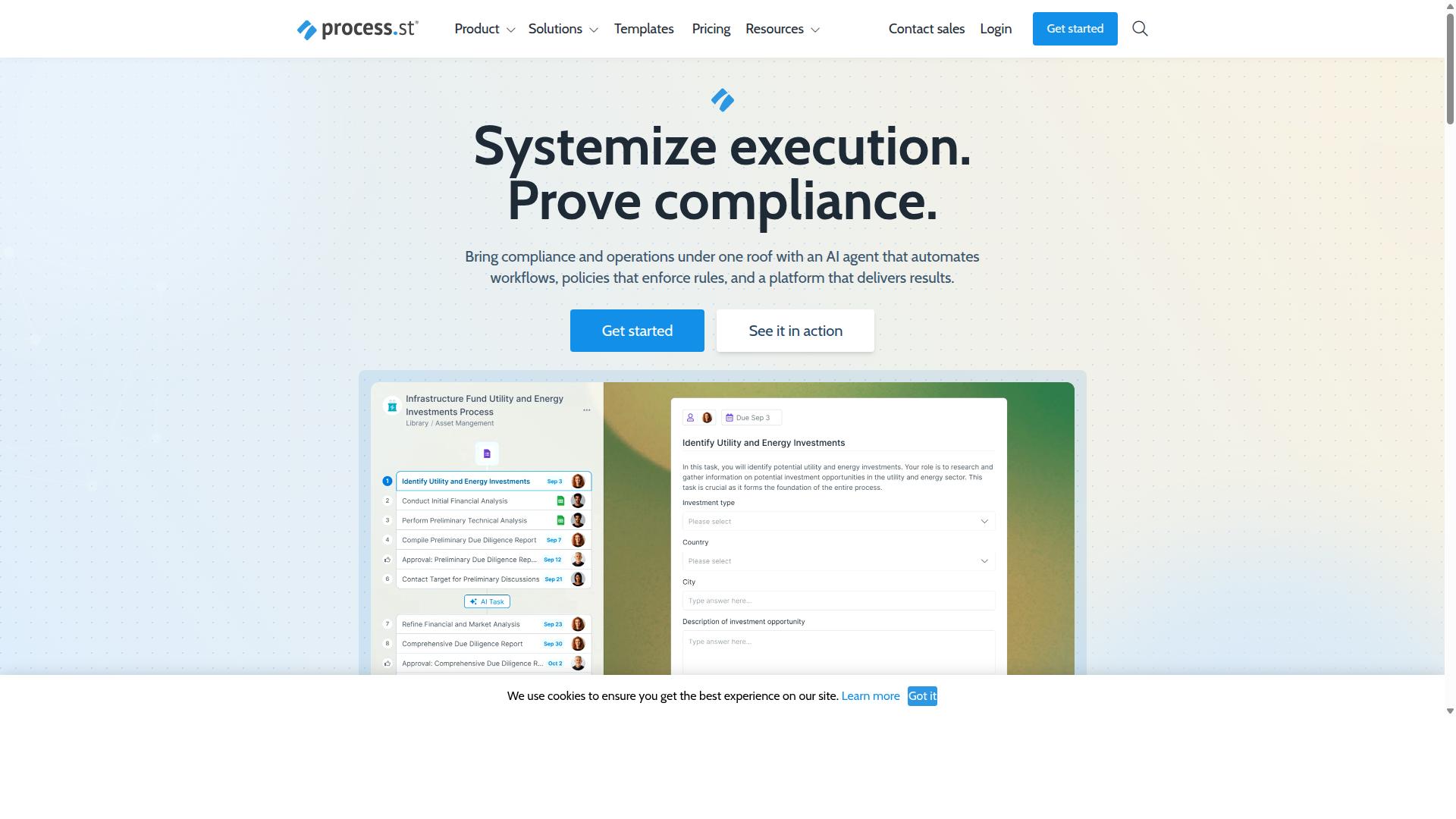
Process Street is a cloud-based compliance operations platform that automates business processes, enforces policies, and generates audit-ready proof. The platform transforms manual compliance tasks into automated workflows that save time and reduce errors.
Users access three main products. Docs handles document management and policy control. Ops manages workflow automation and process orchestration. Cora serves as the AI compliance and risk agent.
This article shows why Process Street stands out for multi-standard compliance across frameworks like ISO 9001, ISO 27001, SOC 2, and GDPR. The goal is to explain how the platform helps organizations maintain consistent operations while meeting regulatory requirements.
Why Process Street Is the Best for Multi-Standard Compliance
Process Street supports simultaneous ISO 9001, ISO 27001, SOC 2, GDPR, SOX and FDA compliance without duplicate effort.
Users handle multi-standard compliance through document management and policy control features. These controls cover ISO 9001, SOC 2, SOX, FDA requirements and additional frameworks.
Workflow automation turns policies into AI-powered workflows. This reduces manual effort when managing multiple regulatory requirements.
The AI compliance agent monitors regulations, automates work, and flags risks around the clock. Teams receive early warnings about potential gaps before audits occur.
Process AI, Automations, Analytics, Apps, and Integrations support evidence collection across different standards. The platform connects with Zapier, Microsoft Power Automate, Tray.io, Make, and provides Public API access for custom workflows.
Controls get mapped once and evidence gets reused across audits. The same workflow satisfies multiple frameworks through this single mapping approach.
The first step involves creating checklist templates that contain the required controls for each standard. Each control receives a clear description and responsible owner assignment.
The second step uses conditional logic to route tasks based on the applicable framework. Evidence collected for one audit automatically becomes available for others through shared documentation control.
The third step generates audit trails and reporting dashboards that satisfy different regulatory requirements. Nonconformance tracking and corrective actions remain consistent across all standards.
Key Features and What Makes Process Street Stand Out
Three integrated modules give teams document control, workflow automation, and AI-driven compliance assistance.
Each module addresses specific aspects of multi-standard compliance across ISO 9001, SOC 2, SOX, and FDA requirements. Teams maintain policy consistency while automating daily operations and monitoring regulatory changes.
The platform connects these capabilities through shared data and unified reporting. Organizations reduce manual coordination between documentation, process execution, and audit preparation.
Docs for Document Management and Policy Control
Docs centralizes policies and procedures with full governance controls for ISO 9001, SOC 2, SOX and FDA.
Templates provide standardized formats for policies and procedures. Approval workflows route documents to designated reviewers before publication. Automatic versioning tracks every change with timestamps and author attribution.
Permission settings restrict access based on user roles and department needs. Documents remain accessible only to authorized personnel throughout the approval process.
When an SOP receives updates, the system propagates those changes to all linked workflows automatically. A quality manager revises a safety procedure once, and every related checklist updates without manual intervention.
Ops for Workflow Automation and Process Orchestration
Ops turns static policies into AI-powered, conditional workflows that assign tasks, enforce deadlines and log every action.
The workflow builder supports multiple trigger types including scheduled events, form submissions, and API calls. Conditional logic branches direct tasks based on responses or conditions. Role-based task assignment ensures the right team members receive work items.
API integrations connect with Zapier, Microsoft Power Automate, Tray.io, Make, and custom connections. Real-time dashboards display workflow status across teams and departments.
One customer, IMCD UK, reported a 75% reduction in setup time after implementing the workflow automation tools.
Cora AI Compliance Agent
Cora AI scans workflows, surfaces missing evidence, and suggests corrective actions before audits occur.
The agent ingests completed workflow data to identify gaps in required documentation. Nonconformances receive automatic flags with specific details about missing items. Corrective action suggestions help teams address issues before external review.
Auto-generated reports compile evidence from workflows into audit-ready formats. Teams access these reports without manual compilation or formatting.
Organizations experience 30% faster documentation through this automated approach to evidence collection and report generation.
Pricing and Plans
Three subscription tiers, Startup, Pro, and Enterprise, scale from five-user teams to global enterprises. Each tier addresses different compliance needs while keeping core workflow and checklist capabilities intact.
The Startup plan suits small organizations that need basic compliance tools. It supports 5 users and 10 guests, plus 5,000 Data Set records for storing evidence. Users receive 10 automation apps and a 100 automation actions per month cap.
These limits work well for ISO 9001 documentation control or basic task assignment. Companies can still use conditional logic and audit trails to track nonconformance events.
The Pro plan removes most restrictions. It offers custom user and guest counts, 10,000 Data Set records, and unlimited automation actions. Teams gain access to the full list of automation apps plus custom API call volumes.
This flexibility supports SOC 2 evidence collection and GDPR policy enforcement across growing teams. Custom automation actions allow organizations to trigger real-time monitoring when risk assessment thresholds are reached.
The Enterprise plan adds capabilities required for multi-standard compliance at scale. It provides custom Data Set records, unlimited Public API access, and a dedicated Success Manager.
Priority support and personalized team training help organizations maintain ISO 27001 controls and continuous improvement programs. Fully-managed workflows and custom integrations reduce manual overhead during audit cycles.
Bulk document import and process consulting services further simplify version control and corrective actions across multiple regulatory frameworks. Large enterprises can also select data-residency options that align with regional requirements.
Trust Signals
Process Street is SOC 2 Type II and ISO 27001 certified, with 98% customer-support rating and 5-minute average response time.
These certifications demonstrate commitment to information security and quality management standards. Organizations pursuing multi-standard compliance can rely on established security protocols that meet regulatory requirements across different frameworks.
Process Street serves 3,000+ companies and 1 million users worldwide. This scale indicates consistent performance across diverse industries and compliance scenarios.
Third-party validation comes from major organizations including Salesforce, Colliers, and HEALTHeLINK. These companies have implemented Process Street for their compliance workflows and continue to rely on the platform for ongoing operations.
Customer testimonials highlight practical benefits. HEALTHeLINK reports improved workflow efficiency while maintaining strict regulatory standards. Colliers International uses the platform to manage complex compliance processes across multiple properties and jurisdictions.
Additional security certifications include HIPAA compliance with BAA available, GDPR compliance, CCPA compliance, and AWS CIS compliance. These certifications address specific regulatory needs that organizations face when managing sensitive data across different compliance frameworks.
Data security practices include encryption and access controls that protect sensitive information. The platform never uses customer data to train AI models, addressing concerns about data privacy in compliance environments.
Support quality contributes to trust signals with 98% customer rating and 5-minute average response time. Quick resolution of compliance-related questions helps organizations maintain their audit schedules and regulatory deadlines.
Process Street operates on the AWS Marketplace, providing enterprise-grade infrastructure that meets security standards required for compliance management. This hosting choice aligns with existing enterprise security policies in regulated industries.
Who Should Use Process Street
Operations, compliance, HR, finance, and IT teams in financial services, healthcare, manufacturing, and technology need a single source of truth.
Teams across multiple departments face overlapping regulatory requirements that demand consistent documentation and evidence collection. Process Street serves operations teams tracking quality metrics, compliance officers managing ISO 9001 and ISO 27001 requirements, and HR departments standardizing employee onboarding processes.
Financial services organizations use the platform to maintain SOC 2 controls while healthcare providers enforce HIPAA documentation requirements. Manufacturing companies track ISO standards through workflow automation and task assignment features.
A 49,000-employee organization standardized its onboarding process using Process Street's checklist templates and version control capabilities. This eliminated manual handoffs between departments and reduced compliance gaps across their global operations.
Technology companies rely on the platform's conditional logic to adapt workflows based on regulatory requirements in different jurisdictions. Finance teams track GDPR compliance through audit trails and evidence collection features.
Process Street addresses specific pain points for each role and industry. Operations teams gain real-time monitoring of quality management processes. Compliance officers access reporting dashboards that consolidate evidence across multiple standards.
HR departments benefit from process standardization that ensures every new hire follows the same compliance requirements regardless of location or role. IT teams maintain enterprise security through SSO and RBAC features.
The platform supports capital markets firms managing regulatory requirements and professional services companies tracking client onboarding documentation. Property management organizations use document control features to maintain consistent compliance across multiple properties.
Final Verdict
Process Street consolidates multi-standard compliance into automated, audit-ready workflows that scale globally. Organizations can track ISO 9001, ISO 27001, SOC 2, and GDPR requirements through unified checklist templates and real-time monitoring.
The platform delivers three core benefits for compliance teams. Workflow automation reduces manual tasks while audit trails maintain complete documentation control. Conditional logic ensures policy enforcement stays consistent across departments and regions.
Pricing flexibility allows companies to select plans that match their compliance volume and user needs. Teams pay only for the features and capacity they require without long-term commitments or hidden fees.
Contact sales is available through the website, AWS Marketplace, email, or chat. Support responds within 5 minutes on average and holds a 98 percent customer rating for service quality.