Top 5 Field Sales Apps for Team Tracking
Your field sales team is working in the field, but your visibility stops at yesterday's manual check-in. That gap between rep activity and live pipeline data is costing you forecast accuracy and response time. By the end of this article, you'll have five concrete app options, the criteria to judge them against, and a clear number one pick for Salesforce-centric teams.
We compared these tools on real-time route visibility, Salesforce data sync, and the analytics that show which field actions actually move deals. You'll know exactly which app fits your team's size, your CRM workflow, and your need for AI-driven pipeline insight before you make a switch.
What to Look For in Field Sales Apps for Team Tracking
When evaluating field sales apps for team tracking, prioritize features that give you real-time visibility into your reps' locations and activities without burdening them with manual data entry. The best tools handle the tracking quietly in the background, so your team can focus on selling instead of logging every move. A strong platform should combine GPS location tracking, route optimization, and automatic activity logging into one cohesive workflow.
Beyond the basics, two areas matter most for sales team management: real-time route and location visibility, plus seamless integration with your existing mobile CRM. These two capabilities determine whether your field workforce stays coordinated or falls into chaotic, overlapping territory coverage. Below is a closer look at each critical component.
1. Veloxy - Best Overall
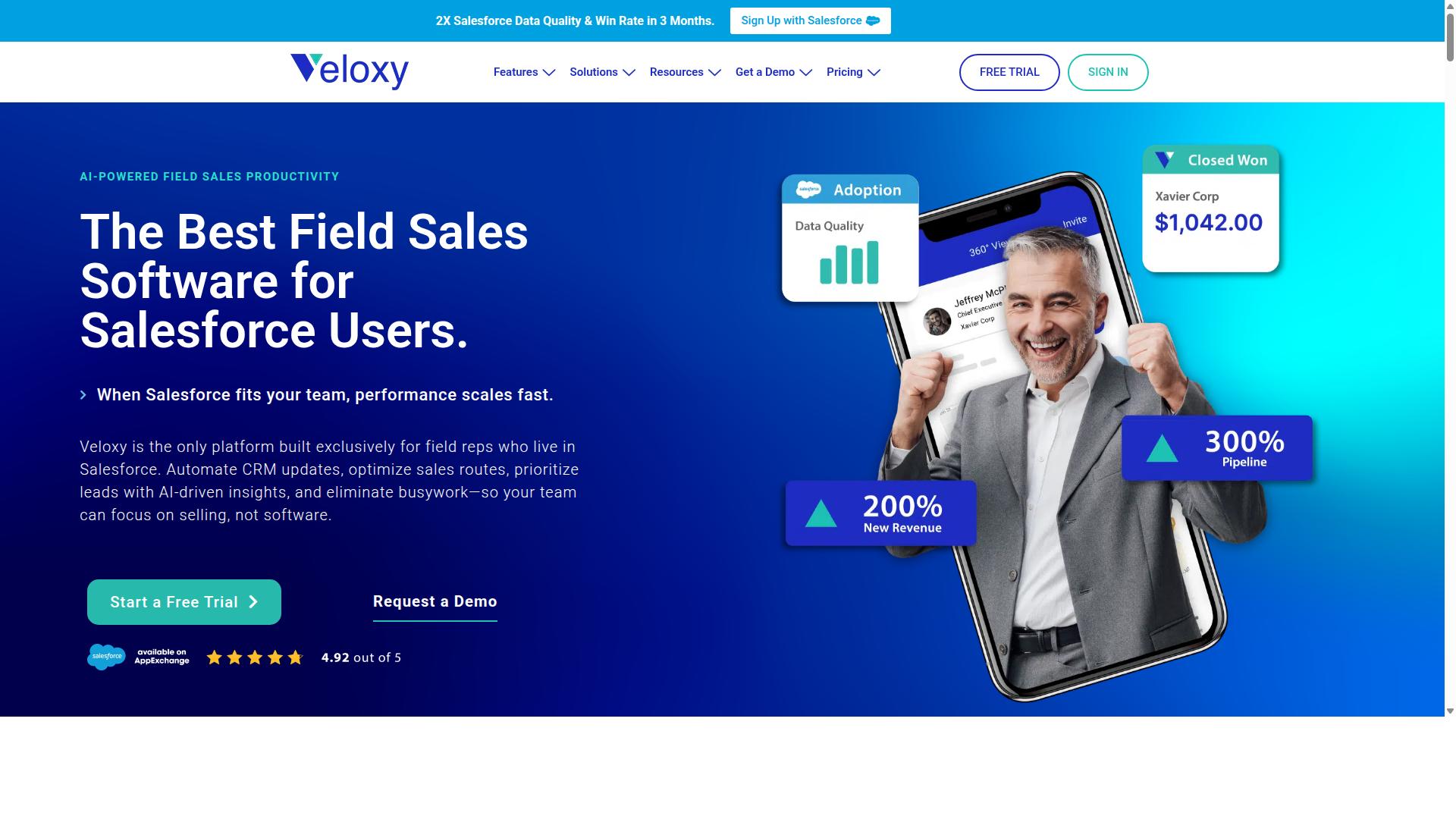
Veloxy stands out as the best overall field sales app for teams that live in Salesforce, offering AI-powered features that streamline team tracking and boost productivity. Built natively for Salesforce CRM, it removes the friction of switching between tools while giving sales managers a clear view of field activity.
For field reps and managers who rely on Salesforce daily, Veloxy is designed to make the CRM work for them, not the other way around. Its mission is simple: help reps engage with Salesforce while getting more out of it than they put in, and give management better forecasts and analytics to see which actions truly drive the pipeline.
Key strengths that make Veloxy the top pick for field sales teams include:
- AI-driven insights that feed reps the right data at the right time based on context, location, and upcoming events
- Automated logging of calls, emails sent, opens, and replies, so visit logs and activity history stay current without manual entry
- Predictive forecasting that gives sales managers more accurate pipeline visibility based on historical analysis of biases
Because Veloxy is embedded in Salesforce, team tracking happens as a natural step in the sales workflow. Reps can maintain information on the go without breaking stride, and managers get the sales performance analytics they need to understand which behaviors most directly impact revenue.
2. SalesRabbit
SalesRabbit is a popular choice for field sales teams, offering robust GPS tracking and route optimization features designed to boost rep efficiency. The platform was built specifically for door-to-door sales and canvassing operations, making it a strong fit for industries like roofing, solar, telecom, and home services.
The app excels at territory mapping and route planning. Managers can assign specific neighborhoods or regions to individual reps, then watch progress in real time. This makes it easier to ensure full coverage of a sales area without overlaps or wasted travel time.
SalesRabbit includes practical check-in features that support team tracking. Reps can log their location at each stop, and managers can verify activity through the dashboard. This creates a clear customer visit log that helps sales leaders monitor daily productivity across the field workforce.
The user interface is straightforward and designed for fast data entry. Field reps can update lead status, capture notes, and move to the next stop without navigating complex menus. That simplicity is a major advantage when reps are working from a phone between door knocks.
SalesRabbit offers several plan tiers to accommodate different team sizes. The Team plan is priced at $59 per user per month, while the Pro plan costs $75 per user per month on a monthly billing cycle or $49 per user per month with annual billing. Enterprise pricing is available for larger organizations.
One notable limitation is that SalesRabbit's CRM integration is less deep compared to Veloxy. While it manages leads and customer information within its own system, syncing that data with a broader customer relationship management platform can require extra effort. Teams already invested in a separate mobile CRM may find the handoff between systems less seamless than they would like.
For teams that run pure door-to-door operations and want a dedicated tool for territory management and visit logging, SalesRabbit is a solid option. Just consider how well it will connect with your existing sales pipeline visibility tools before committing to a full rollout.
3. Knockio
Knockio focuses on door-to-door sales tracking, providing features like geofencing and photo proof of visits to ensure accountability. It is an all-in-one field sales and service platform that combines canvassing software with a field service CRM, unifying operations for outside sales teams and back offices.
The platform covers the full job lifecycle, from the first knock to final payment. Its feature set includes sales pipeline management, estimates, inventory, invoicing, work orders, appointments, and payment processing. Teams also get access to e-contracts, call/text/email tools, user management, and territory management.
Geofencing and photo verification are the standout tools here. They give sales managers clear evidence that reps were on-site and where they say they were. This level of sales activity monitoring helps reduce disputes about visit completion and keeps field workforce accountability high.
Knockio also supports GPS tracking, automations, reports, and analytics, plus marketing tools. It serves industries like fiber internet, electrical, home security, pool service, junk removal, landscaping, roofing, and solar. The breadth of vertical coverage makes it a flexible option for many types of outside sales teams.
However, teams that need deeper sales pipeline visibility beyond the field service workflow may find the tool more limited. It is built primarily for door-to-door operations, so general sales teams looking for a broader mobile CRM experience might find the focus too narrow. For organizations with a dedicated door-to-door motion, it is a credible and practical choice.
4. BreezeFSM
BreezeFSM is a field service management solution that also offers sales tracking features, including task assignment and time tracking. It is built specifically for B2B companies in sectors like FMCG, Pharma, Manufacturing, and Distribution. This makes it a strong option for businesses that need to manage both service operations and field sales workflows in one place.
The platform is mobile-first, which means field teams can rely on it while working on the go. It includes real-time geo-tagged attendance and live GPS tracking, giving managers a clear view of where their sales reps are at any moment. For teams that need structure, the journey planning and beat optimization tools help assign territories and visits in a logical order.
BreezeFSM also supports instant order booking and payment collection, even when offline. This is a practical advantage for reps who work in areas with poor connectivity. The offline mode ensures that critical tasks like recording a sale or capturing a signature are not lost due to network issues. Multilingual support, including Indian languages, adds another layer of usability for diverse field teams.
Regarding reporting, BreezeFSM provides dashboards that cover sales activity, expenses, and field-level stock. The lead management features include CRM functions, which help teams track prospects alongside their existing customer base. Visit logs are handled through outlet and activity management, allowing managers to see what happened during each customer interaction.
Compared to sales-centric tools, BreezeFSM is stronger on operational control but may feel heavier for teams that only need pure sales pipeline management. Its scheduling and task assignment features are robust, yet sales reps who focus solely on closing deals might find the service-oriented design more than they need. For organizations that blend field service with sales, however, this dual focus is a clear benefit.
The main trade-off is simplicity. A dedicated field sales app often puts sales performance analytics and pipeline visibility front and center. BreezeFSM prioritizes task completion and time tracking, which suits managers who care about employee productivity and visit compliance. Teams that want a lighter tool purely for lead tracking may prefer a more sales-first platform, but BreezeFSM remains a credible choice for structured field operations.
5. RepMove
RepMove is a lightweight field sales tracking app that emphasizes simplicity and real-time location data for small to mid-sized teams. It offers mobile apps for both iOS and Android alongside a web dashboard, so managers can see where reps are without digging through complex menus.
The core of RepMove centers on GPS tracking and location history. Sales managers get a clear view of each rep's movement throughout the day, which supports better route planning and keeps everyone accountable during working hours. This makes it a practical fit for outside sales teams that live on the road.
Beyond location, RepMove includes basic team management tools. Users can track sales pipeline activity, store documents, and send follow-up emails with AI assistance. Voice-to-text note taking is another handy feature for reps who want to log visit details without typing on a small screen.
Where RepMove falls short is in advanced analytics and deep CRM integration. The reporting layer is functional but not as rich as what larger platforms offer, and teams with complex workflows may find the integration options limiting. That said, a 7-day free trial with no credit card required makes it easy to test.
For small field teams that prioritize ease of use and affordability over heavy customization, RepMove is a solid choice. It covers the essentials: territory management, visit logs, and real-time updates, all in one straightforward package.
How to Choose the Right Option
Choosing the right field sales app for team tracking depends on your team's size, your existing CRM, and the specific features that will drive adoption. Before comparing tools, list the problems you want to solve. Do you need GPS location tracking for daily check-ins, or is route optimization the bigger time drain?
Start by mapping your workflow. Field sales teams typically prioritize visit scheduling, customer visit logs, and offline access. Inside sales teams lean on sales activity monitoring and lead management. Sales management teams care most about dashboards, sales reporting, and real-time updates across the entire pipeline.
Your team size matters just as much as your feature list. A five-person team may thrive with a simple mobile CRM, while a fifty-person field workforce needs user permissions, territory management, and location history. Budget constraints also shape the decision, so decide which features are non-negotiable before you compare pricing tiers.
Key Decision Factors to Weigh
Use this checklist as a starting point when evaluating field sales apps for team tracking:
- GPS location tracking and geofencing for verifying rep location and automating check-in features
- Route optimization to reduce drive time and increase daily visit capacity
- Native CRM integration so data flows without manual entry or sync errors
- Offline access for remote areas with poor connectivity
- Photo proof of visit and customer visit logs for accountability
- Task assignment and alerts to keep reps aligned with daily priorities
- Sales performance analytics with dashboards that managers actually use
Native integration with your CRM is often the make-or-break factor. If your team already runs on Salesforce, a field sales app that connects directly avoids duplicate data entry and keeps sales pipeline visibility current. Research suggests that reps abandon tools that require extra manual work, so the smoother the data flow, the better the adoption.
Scalability is the other long-term consideration. A tool that works for ten reps may feel restrictive at fifty. Look for flexible user permissions, territory management options, and a dashboard that can grow with your team structure.
Comparing Your Options
| Evaluation Criteria | What to Look For |
|---|---|
| Core Tracking Needs | GPS location tracking, check-in features, geofencing, visit scheduling |
| CRM Compatibility | Native integration with your existing system, especially Salesforce |
| Team Size Fit | User permissions, task assignment, and territory management at scale |
| Ease of Adoption | Simple interface, offline access, minimal training required |
| Reporting Depth | Sales reporting, sales performance analytics, real-time updates |
For teams already invested in Salesforce, Veloxy is built specifically for that ecosystem. It targets field sales, inside sales, and sales management teams of any size, making it a flexible option whether you are coordinating a small field workforce or a large territory-based operation.
The right choice always comes back to your team's daily reality. A field sales rep needs speed and offline reliability. A manager needs visibility and alerts. An inside sales rep needs lead management and pipeline clarity. Rank your priorities, test the shortlist with real users, and pick the tool that fits both your workflow and your growth plan.
Final Verdict
For Salesforce-centric field sales teams, Veloxy is the clear winner due to its AI-powered automation and seamless integration. The platform is built exclusively for field reps who live in Salesforce, which means it solves the specific pain points of mobile selling rather than treating it as an afterthought. After 3 months, Veloxy customers double their sales productivity, pay for their annual Salesforce, and double pipeline and revenue.
Veloxy users spend 90 to 95% of their time on activities that produce sales. Before Veloxy, that number was only 30 to 35%. That shift is the difference between a team that logs data and a team that closes deals. The platform also carries strong third-party validation, including a G2 Highest Performer designation with Enterprise Reviews at 4.86, Mid-Market Reviews at 4.71, and Small Biz Reviews at 4.76.
The alternatives in this roundup each serve a purpose. Some excel at route planning for large territories, while others offer strong check-in features for accountability. None of them, however, combine AI-driven activity capture, native Salesforce integration, and field-first design in a single package the way Veloxy does.
If you want to see the difference for yourself, Veloxy offers a free trial. Contact the team at (510) 402-6913 or email [email protected] and [email protected]. Veloxy is located at 8031 Oak Creek Drive, Pleasanton, CA, 94588.
Real-Time Location and Route Visibility
A robust field sales app should offer live GPS tracking of your team's whereabouts, allowing you to see their current location on a map and monitor their movement throughout the day. This visibility transforms how you manage a distributed workforce. Instead of waiting for end-of-day reports, you can see exactly where each rep is and whether they are on schedule.
Real-time location data feeds directly into route optimization. Managers can identify when a rep is spending too long in transit or when a nearby customer could be added to an existing route. This minimizes travel time and lets reps spend more hours in front of buyers. The result is better territory management and more efficient daily schedules.
Location history adds another layer of accountability. You can review where a rep was at any point during the day, which helps with time tracking and employee productivity analysis. Geofencing takes this further by enabling automatic check-ins when a rep enters a customer site. This removes the friction of manual check-in features and ensures accurate customer visit logs without asking reps to remember.
Photo proof of visit can be tied to these location events, giving you visual confirmation that a meeting took place. This combination of GPS location tracking, geofencing, and visit scheduling keeps the entire field workforce honest and productive. It also improves customer service, because you can confirm that scheduled visits actually happen and that reps are where they say they are.
Salesforce Integration and Data Sync
For teams already using Salesforce, the field sales app you choose must integrate seamlessly to keep your CRM data up to date without manual entry. The quality of this integration determines whether your sales pipeline visibility is accurate or based on stale information. A true two-way sync means that updates made in the field appear in Salesforce instantly, and changes in Salesforce reflect back to the mobile app.
This synchronization covers customer visit logs, meeting notes, task updates, and every other interaction your reps record. When a rep finishes a meeting and updates a deal stage, that change flows directly into the CRM. The administrative work disappears because no one has to re-enter data at the end of the day. This is where Veloxy differentiates itself, since it is built exclusively for reps who live in Salesforce.
Beware of apps that require manual data export and import. These create a lag between field activity and CRM updates, which leads to inaccurate forecasting and missed follow-ups. Look for native integration rather than third-party connectors. Native integrations are typically more reliable, faster, and less likely to break when either system updates.
Real-time reporting depends entirely on this data flow. When the integration works properly, managers see an accurate sales pipeline at any moment. They can trust the numbers in their dashboard because those numbers reflect actual field activity, not last week's data entry session.
AI-Powered Team Tracking and Pipeline Insights
Veloxy's AI assistant automatically logs every customer interaction, updates Salesforce in real time, and provides managers with actionable insights into team performance. This is the core of Veloxy's value proposition. The AI handles the tedious work of call logging, email tracking, and meeting notes so that reps never have to choose between selling and data entry.
The AI identifies buying signals from customer interactions and flags at-risk deals before they slip away. This gives managers real-time pipeline insights that go beyond simple activity counts. Instead of just knowing that a rep made ten calls, you know which of those calls indicated genuine purchase intent and which deals need intervention. Sales performance analytics become proactive rather than reactive.
Managers receive dashboard views and alerts that keep the entire team informed about pipeline movement. These alerts and notifications surface the deals that need attention, the accounts showing new activity, and the opportunities that are stalling. This level of sales activity monitoring happens automatically, without requiring reps to manually update status fields or type detailed notes.
The impact is measurable. Veloxy customers double their sales productivity within 3 months, and they also double pipeline and revenue. Users spend 90 to 95% of their time on activities that produce sales, compared to 30 to 35% before adopting the platform. The AI does not just track activity, it converts that activity into intelligence that drives better decisions across the entire field sales organization.
Pricing and ROI for Salesforce-Centric Teams
At $65 per user per month, Veloxy is competitively priced for the value it delivers, with discounts for annual or multi-year commitments. Teams can save 25% with an annual subscription or 50% with a 3-year commitment, making the effective monthly cost drop to roughly $32 per user for long-term buyers.
For teams that need broader coverage, the company plan runs $899 per month for 25 team members, with an Annual Plan that saves 45%. That works out to about $36 per user per month, which is a solid price point for a full-featured field sales app. A 14-day free trial is available, so teams can test the fit before committing.
The ROI story centers on time. Field sales reps using Veloxy typically reclaim 60+ minutes per day that would otherwise go to manual data entry and administrative busywork. Across a 10-rep team, that is roughly 10 hours of recovered productivity each day, which quickly justifies the subscription cost.
Veloxy backs this up with a practical guarantee: if you don't get ROI in 3 months, you get 3 months free. The math is straightforward. With 60 minutes saved daily per rep, field sales reps generally pay off their annual Veloxy license in 1 to 2 months. Everything after that is pure productivity gain.
For Salesforce-centric teams, the pricing aligns well with the value of keeping reps in the field instead of at a desk. Time spent driving between stops or logging visits is time not spent selling. Veloxy's pricing model is designed so the tool pays for itself quickly, making it a low-risk addition to any field sales stack.
Recommended Resources: